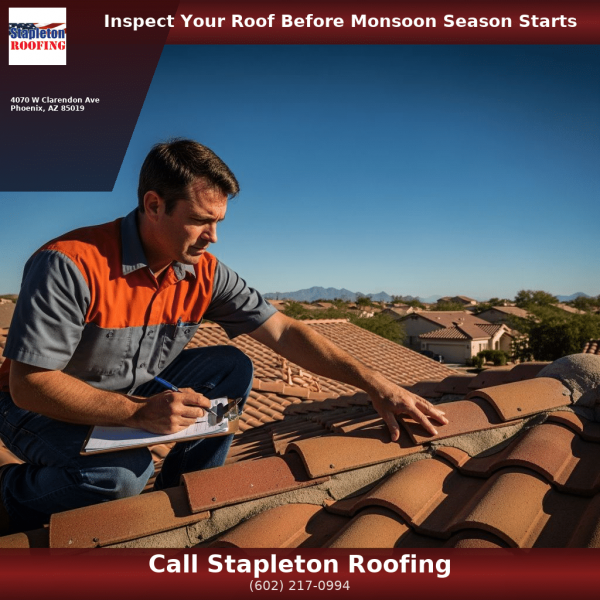
What Phoenix Homeowners Should Inspect on Their Roof Before Monsoon Season Starts
Key Takeaways:
- Phoenix homeowners should complete a visual roof inspection in May — before UV-weakened materials meet the destructive wind and rain of the monsoon season starting mid-June.
- There is a meaningful difference between what you can safely check yourself (lifted tile caps, granule loss, debris in drainage valleys) and what requires a licensed roofer (underlayment condition, flashing bonding, deck integrity).
- Scheduling a pre-monsoon inspection with Stapleton Roofing Company is straightforward, no-obligation, and takes the guesswork out of knowing whether your roof is ready for July haboob conditions.
Every May, the same window opens across Maricopa County. Temperatures are climbing, the skies are still clear, and Phoenix homeowners have roughly six weeks before monsoon season officially begins on June 15. That window is the best time to do one thing that protects everything under your roof: a pre-monsoon inspection.
A roof inspection before the monsoon season, which Phoenix homeowners often skip, is often the one they regret by August. This article walks you through what you can realistically check yourself, what should go on a licensed roofer’s list, and why the timing of the Phoenix climate cycle matters more than most people realize.
What You Can Safely Check From the Ground and Attic
You do not need to be a contractor to spot early warning signs. A careful visual pass — binoculars from the ground, a flashlight in the attic — can reveal problems worth flagging before conditions get worse.
Here is what to look for:
Lifted or cracked tile caps. Ridge caps take the brunt of the wind load. In Phoenix, the sustained gusts during a haboob can exceed 60 mph. If cap tiles are already cracked or have shifted, even slightly, they are likely to lift and break during the first major storm.
Granule loss in your gutters and downspout splash zones. If you scoop a handful of dark grit out of your gutters in May, that is not just debris — it is asphalt shingle material. Granule loss signals UV degradation. Phoenix receives intense direct sun from March through June, and shingles that have shed significant granule coverage are structurally thinner and more vulnerable to water intrusion once rain arrives.
Flashing separation around skylights, pipe boots, and vent stacks. Stand at the edge of your roofline and look upward with binoculars. Anywhere metal flashing meets a tile, shingle, or penetration point is a potential failure zone. If you can see daylight between the flashing and the surrounding material, or if caulk has turned white and brittle, that joint is no longer watertight.
Debris accumulation in drainage valleys. Phoenix roofs are often low-pitch or flat in sections, and the valleys between roof planes collect leaf litter, seed pods from palo verde and mesquite trees, and wind-blown dust that packs into a dam over time. A backed-up valley does not drain during heavy rainfall, and during the monsoon, Phoenix can receive more than one inch of rain per hour in isolated microbursts.
Attic signs of prior moisture. A flashlight inspection of your attic decking in May can reveal staining, soft spots, or daylight gaps you did not know existed. Monsoon is not your first alert — the damage is already there.
What a Professional Roof Inspection Actually Evaluates
There is a real difference between a homeowner’s visual pass and what a licensed roofer assesses when they walk the roof surface. Understanding that gap helps you know when to call.
A professional inspector evaluates the condition of the underlayment — the layer between your tiles or shingles and the decking beneath. In Arizona, underlayment degrades faster than in humid climates due to the combination of extreme UV exposure and thermal cycling. A roof can look perfectly intact from the street while its underlayment has become brittle and cracked. You cannot see this without removing tiles.
Deck integrity is another factor only a professional can assess on foot. Soft spots in the deck indicate prior moisture infiltration and pose a structural risk during high-wind events. Walking the surface allows a roofer to identify delamination and flex that no binocular inspection can detect.
Flashing bonding is also beyond a visual-only assessment. Flashing that appears seated may have lost its adhesive bond or sealant integrity below the surface. A roofer applies pressure tests and inspects from both sides of penetrations to confirm the joint is actually watertight, not just cosmetically intact.
Additionally, a licensed inspector documents their findings in a written report, which helps protect you from disputes if a storm claim is later filed with your homeowners’ insurance.
Why Phoenix Timing Makes This Urgent
The Arizona monsoon season officially runs from June 15 through September 30, according to the National Weather Service Phoenix office. But the conditions that damage your roof before the first storm arrives are already at work in April and May.
Phoenix averages more than 300 sunny days per year, and the UV index regularly reaches 11 or higher in late spring. That exposure breaks down asphalt binders, oxidizes sealants, and dries out the polymers in underlayment. A roof inspected in March and found to be in good shape may have lost meaningful integrity by mid-June, simply because of what Phoenix spring does to roofing materials.
This is why a pre-monsoon inspection is a distinct need, not a repackaged fall checkup. The threat profile here is specific: intense UV degradation, followed immediately by high-velocity particulate wind (haboobs), then heavy rainfall that arrives quickly and pools quickly on flat or low-pitch sections. Materials are weakest exactly when the hardest conditions hit. In 2026, the window to catch degradation before the season’s first system is particularly narrow — act early.
What Scheduling a Pre-Monsoon Inspection With Stapleton Looks Like
Stapleton Roofing Company serves homeowners throughout the greater Phoenix area. A pre-monsoon inspection is a no-obligation service: someone who knows Arizona roofing conditions walks your roof, documents what they find, and gives you a clear picture of what is ready and what is not.
The process is simple. You call or request an appointment online, and a team member schedules a visit that fits your schedule. The inspection covers the items professional roofers assess — underlayment condition, flashing integrity, deck soundness, drainage capacity — and you receive a written summary. If repairs are recommended, you get an estimate with no pressure to commit on the spot.
The most common feedback homeowners receive is reassurance: most roofs need minor attention, not a full replacement. Knowing exactly where you stand before June 15 is the point.
Do not wait for the first monsoon storm to tell you what a May inspection would have shown. Contact Stapleton Roofing Company now and schedule your pre-monsoon roof inspection while the season is still on your side.
Frequently Asked Questions About Roof Inspection Before Monsoon in Phoenix
How early should I schedule a roof inspection before the monsoon season in Phoenix?
The ideal time is May, which gives you enough runway before the June 15 monsoon season start date to complete any needed repairs without rushing. Scheduling earlier also means you avoid the late-spring backlog that roofing companies in the Phoenix area typically see in early June.
Can I do the entire pre-monsoon roof inspection myself?
You can complete a meaningful visual pass from the ground or attic — checking for lifted tile caps, granule loss, flashing gaps, and debris in drainage valleys. However, assessments of underlayment condition, deck integrity, and bonded flashing require a licensed roofer on the roof surface. Those cannot be safely or accurately evaluated without professional training and physical access.
What types of damage does the monsoon season most commonly cause to Phoenix roofs?
The most frequent types of monsoon-related roof damage in the Phoenix area include lifted or broken tile from haboob wind loads, flashing failure at vent penetrations and skylights, ponding water on flat roof sections during high-rainfall microbursts, and debris-caused drainage blockages that redirect water under tile or shingle edges.
How much does a pre-monsoon roof inspection typically cost in Phoenix?
Inspection costs vary by company. Stapleton Roofing Company offers no-obligation inspections, meaning there is no fee simply to have a professional evaluate your roof’s condition and provide a written assessment. If repairs are recommended, an estimate is provided separately.
Will my homeowner's insurance cover monsoon storm damage if I skipped an inspection?
Insurance coverage decisions depend on your specific policy terms and the nature of the damage. However, insurers may question claims where pre-existing deterioration contributed to storm damage — and a pre-season inspection that documents your roof’s condition before the storm is a protective record in your favor. Consult your policy or insurance agent for specifics related to your coverage.
Why Trust Stapleton Roofing Company
Stapleton Roofing Company is a family-owned and locally operated roofing contractor serving homeowners and businesses across Arizona. With more than 40 years of experience, we have earned a reputation as one of the most trusted and respected names in the roofing industry. Our team of licensed, bonded, and insured professionals provides comprehensive roofing services designed for Arizona’s demanding climate—from the intense desert sun to seasonal monsoon rains.
As leading Arizona roof contractors, our mission is simple: deliver honest service, unmatched workmanship, and roofs that stand the test of time. Every project we complete reflects our values—integrity, quality, and safety—and our dedication to customer satisfaction has made us the first choice for thousands of homeowners and businesses statewide.
Our Roofing Services Include:
- Roof Repair: Leak detection, tile replacement, storm damage repair, and preventative maintenance.
- Roof Replacement: Full tear-off and installation for shingle, tile, foam, and flat roofing systems.
- Roof Inspections: Certified inspections for real estate, insurance, and property management.
- Commercial Roofing: TPO, foam, and flat roofing systems designed for durability and energy efficiency.
- Residential Roofing: Tile, shingle, and foam roof systems customized for Arizona homes.
- Roof Coatings & Restoration: Energy-efficient roof coatings that extend the lifespan of your roof.
From our office in Phoenix, Stapleton Roofing Company proudly serves customers across the Greater Phoenix Metro area, including Scottsdale, Glendale, Mesa, Chandler, Surprise, Avondale, Goodyear, Paradise Valley, Cave Creek, Sun City West, and Tempe.
Our team uses only high-quality materials from trusted manufacturers, ensuring that every roofing system we install is built to last and backed by solid warranties. From minor residential repairs to large-scale commercial projects, we approach every job with precision, professionalism, and a no-leak guarantee for the warranty period in your contract.
As active members of the Arizona Roofing Contractors Association (ARCA) and accredited by the Better Business Bureau (BBB), Stapleton Roofing Company continues to set the standard for excellence in the Arizona roofing industry.
Why Homeowners & Businesses Trust Stapleton Roofing Company
- Family-Owned and Operated
- Licensed, Bonded, and Insured (ROC #269773)
- Free Roof Inspections and Honest Estimates
- Daily Site Cleanup and Safety Protocols
- Decades of Proven Experience with Arizona Roofs
Business Locations:
Stapleton Roofing Company – Phoenix, AZ
Serving Central Phoenix, Scottsdale, Tempe, Chandler, and Mesa
Stapleton Roofing Company – West Valley Service Area
Serving Peoria, Glendale, Surprise, Avondale, Goodyear, and the West Valley