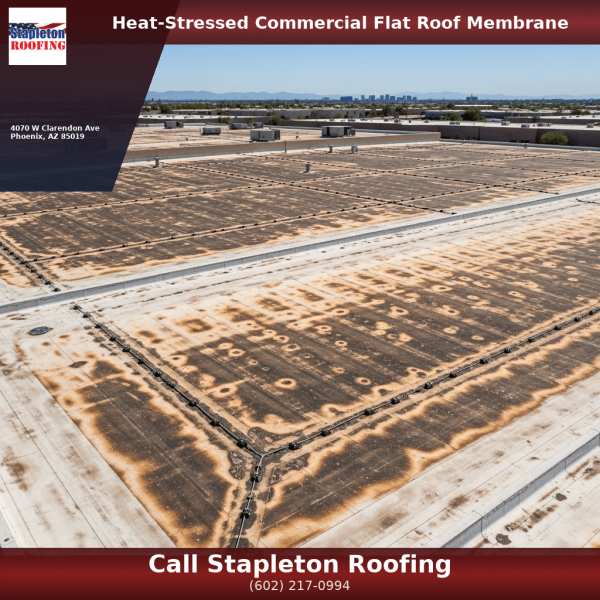
Is Your Commercial Flat Roof Ready for Phoenix Summer?

Commercial flat roof showing heat damage signs in Phoenix AZ

Your Commercial Flat Roof Is Under Attack — And Phoenix Summer Hasn’t Even Peaked Yet

Key Takeaways:

  • Phoenix commercial flat roofs can reach surface temperatures above 170°F in summer, accelerating membrane failure, seam separation, and blistering — often before a single leak appears indoors.
  • TPO, PVC, modified bitumen, and spray polyurethane foam roofs each respond differently to extreme heat, and knowing your membrane type determines exactly what to inspect and when.
  • A pre-summer inspection and a few targeted maintenance steps completed before July can add years to your roof’s service life and prevent five-figure emergency repair bills.

Step onto a Phoenix commercial flat roof at 2 p.m. in July. The surface temperature can exceed 170°F. That is not a typo. While your tenants sit in air-conditioned comfort below, the membrane above their heads is expanding, contracting, softening, and slowly losing the battle against one of the most punishing climates in North America.

The damage rarely announces itself with a dramatic ceiling collapse. Instead, it builds quietly — a softened seam here, a bubbled section there — until one monsoon storm turns a compromised roof into an emergency. By then, you are not dealing with a maintenance cost. You are dealing with a business interruption, damaged inventory, and a repair bill that could have been a fraction of the final number.

Here is what you need to know before July arrives.

Why Phoenix Heat Is a Unique Threat to Commercial Flat Roofs

Most roofing standards are written for climates that see occasional heat. Phoenix is not an occasional-heat city. The metro area routinely records triple-digit temperatures from May through September, and flat roofs absorb far more solar radiation than pitched roofs because they face the sun at a direct angle for more hours each day.

The result is a process called thermal cycling — the membrane expands during peak heat and contracts overnight as temperatures drop into the 80s. In 2026, Phoenix is on track for another record-setting heat season. That daily expansion-contraction cycle stresses every seam, fastener, and flashing attachment on the roof. Over months and years, those micro-movements add up to macro failures.

Two other factors compound the problem specifically in this region:

  • UV intensity at Phoenix’s elevation and latitude degrades membrane plasticizers faster than in cooler markets.
  • Monsoon storms arrive suddenly after weeks of dry heat, sending thermal-shocked membranes into contact with rapid moisture and wind uplift simultaneously.

How Each Membrane Type Responds to Extreme Heat

TPO (Thermoplastic Polyolefin)

TPO is the most common commercial membrane in new Phoenix construction because of its white reflective surface. However, that white surface can yellow and chalk under sustained UV exposure, reducing its reflective value over time. More critically, the hot-air-welded seams soften at elevated temperatures. If the original weld was marginally executed, summer heat is when that seam begins to fail.

Watch for: seam ridging, surface chalking, membrane shrinkage around penetrations, and any area where the membrane has pulled away from a parapet wall.

PVC (Polyvinyl Chloride)

PVC membranes are chemically similar to TPO but contain plasticizers that make the material more flexible. The trade-off is that those plasticizers migrate out of the membrane over time — a process that summer heat accelerates. A PVC roof that is seven or more years old in Phoenix may be noticeably stiffer and more brittle than it was at installation.

Watch for: surface crazing (a fine cracking pattern), brittleness around drains and penetrations, and any ponding water areas where plasticizer migration is fastest.

Modified Bitumen

Modified bitumen roofs — either APP or SBS modified — are dark-surfaced in their base form and absorb significantly more solar heat than white membranes. Surface temperatures on an uncoated modified bitumen roof in Phoenix can be 30 to 50 degrees higher than on a reflective TPO surface. That trapped heat softens the bitumen, causes blistering, and accelerates granule loss on cap sheets.

Watch for: blistering (bubbles of trapped air or moisture under the membrane), alligatoring (a cracked, scaly surface pattern), and granule accumulation in drains after wind events.

Spray Polyurethane Foam (SPF)

Foam roofs are excellent insulators and can be highly durable in Phoenix when properly maintained. However, the protective coating over the foam — typically an elastomeric or silicone layer — degrades under UV exposure and heat cycling. When that coating thins or cracks, the foam beneath absorbs moisture and begins to deteriorate rapidly.

Watch for: surface pitting or cratering in the foam, areas where the topcoat has cracked or peeled, and any soft spots underfoot that suggest moisture intrusion into the foam substrate.

Five Immediate Actions to Take Before July

These steps are specific, sequenced, and actionable. Complete them now, while temperatures are still manageable for rooftop access.

  1. Schedule a professional inspection. A trained roofing technician can identify seam separations, membrane shrinkage, and flashing failures that are invisible from ground level. Aim for early morning when surface temperatures allow safe footing.
  2. Clear all drains and scuppers. Blocked drainage turns a rain event into a ponding event. Standing water adds structural load and accelerates membrane degradation at the contact point.
  3. Check all penetration flashings. HVAC curbs, pipe boots, and conduit penetrations are the first places heat-induced membrane movement creates gaps. Probe gently around each one for softness or separation.
  4. Apply a reflective coating to uncoated modified bitumen sections. A white elastomeric coating can reduce surface temperatures by 40°F or more, directly reducing the thermal cycling stress on the membrane beneath.
  5. Document the current condition with photos. Dated photos create a baseline for tracking change across the season and support any warranty or insurance claims that arise later.

What the Pros Know That Most Building Operators Miss

The biggest misconception in commercial roofing is that the absence of an active leak means there is no active problem. Heat damage is progressive and largely invisible until the membrane reaches a failure threshold. By the time water appears on a ceiling tile, the membrane has typically been compromised for weeks or months.

Experienced roofing professionals look at the roof as a system — not just the membrane surface. The insulation below the membrane, the deck below the insulation, the drainage slope, and the continuity of the flashing all interact. A membrane that looks acceptable on its surface may be sitting on saturated insulation that has lost 30% of its R-value, driving up energy costs and creating a hidden moisture reservoir.

Summer roof maintenance for a commercial building in Phoenix is not a once-and-done task. It is a seasonal discipline. The roofing teams who serve this region see the same pattern year after year: buildings that receive a professional inspection before peak heat and a follow-up check after the first monsoon storms hold up dramatically better than those inspected only after a problem becomes visible.

Your roof is the largest single protective element on your building. Give it the attention it cannot ask for before July.

Frequently Asked Questions About Commercial Flat Roof Heat Damage in Phoenix

How hot can a commercial flat roof get in Phoenix during summer?

Surface temperatures on dark-colored commercial flat roofs in Phoenix regularly exceed 170°F during peak summer hours. White reflective membranes like TPO and PVC run cooler — often in the 120–140°F range — but still experience significant thermal stress. These temperatures are far above what most people realize when planning maintenance schedules.

Early signs include seam ridging or lifting, surface chalking or discoloration, small blisters or bubbles in the membrane, granule accumulation in drains, and minor membrane shrinkage around penetrations and parapet walls. These signs are easy to miss without a close inspection but indicate that the membrane is under stress and approaching a more serious failure.

Most manufacturer warranties cover material defects, not damage caused by environmental conditions or inadequate maintenance. Some warranties include provisions about regular inspections and maintenance as a condition of coverage. Review your specific warranty document and consult your roofing contractor about what documentation — inspection records, photos — you need to maintain in order to keep coverage valid.

Industry best practice for Phoenix commercial properties is a minimum of two professional inspections per year — one before the summer heat season (April or early May) and one after the monsoon season ends (October). High-traffic roofs with many penetrations, as well as older roofs, may benefit from quarterly inspections.

Yes, in most cases, a reflective elastomeric or silicone coating can be applied over an existing membrane provided the substrate is structurally sound, dry, and properly cleaned. Applying a coating over a moisture-compromised or actively deteriorating membrane traps problems and accelerates failure. A professional assessment should confirm the roof is a good candidate before any coating is applied.

Blisters and bubbles both indicate trapped gas or moisture between membrane layers, but their causes differ. Blisters typically form when moisture vaporizes in the membrane assembly under heat. Bubbles can result from installation errors, such as inadequate adhesion during application. Both compromise the membrane’s integrity and should be evaluated by a professional, as the repair approach differs depending on whether moisture is present in the assembly.

Repair costs vary significantly depending on the extent of damage, the membrane type, and the system’s age. Targeted repairs to isolated seam failures or flashing issues are far less expensive than partial or full membrane replacement. The most important cost-control strategy is early intervention — catching problems at the seam-ridge stage is far less expensive than addressing them after water has reached the insulation or deck.

Sources

  1. Phoenix summer heat and temperature records — National Weather Service, Phoenix: https://www.weather.gov/psr/
  2. Roofing membrane surface temperature and reflectance data — U.S. Department of Energy, Building Technologies Office: https://www.energy.gov/eere/buildings/building-envelope
  3. Thermal cycling and membrane fatigue in low-slope roofing — National Roofing Contractors Association (NRCA): https://www.nrca.net
  4. Cool roofs and energy performance — Lawrence Berkeley National Laboratory Cool Roofs: https://heatisland.lbl.gov/coolroofs/

Why Trust Stapleton Roofing Company

stapleton roofing crew

Stapleton Roofing Company is a family-owned and locally operated roofing contractor serving homeowners and businesses across Arizona. With more than 40 years of experience, we have earned a reputation as one of the most trusted and respected names in the roofing industry. Our team of licensed, bonded, and insured professionals provides comprehensive roofing services designed for Arizona’s demanding climate—from the intense desert sun to seasonal monsoon rains.

As leading Arizona roof contractors, our mission is simple: deliver honest service, unmatched workmanship, and roofs that stand the test of time. Every project we complete reflects our values—integrity, quality, and safety—and our dedication to customer satisfaction has made us the first choice for thousands of homeowners and businesses statewide.

Our Roofing Services Include:

  • Roof Repair: Leak detection, tile replacement, storm damage repair, and preventative maintenance.
  • Roof Replacement: Full tear-off and installation for shingle, tile, foam, and flat roofing systems.
  • Roof Inspections: Certified inspections for real estate, insurance, and property management.
  • Commercial Roofing: TPO, foam, and flat roofing systems designed for durability and energy efficiency.
  • Residential Roofing: Tile, shingle, and foam roof systems customized for Arizona homes.
  • Roof Coatings & Restoration: Energy-efficient roof coatings that extend the lifespan of your roof.

From our office in Phoenix, Stapleton Roofing Company proudly serves customers across the Greater Phoenix Metro area, including Scottsdale, Glendale, Mesa, Chandler, Surprise, Avondale, Goodyear, Paradise Valley, Cave Creek, Sun City West, and Tempe.

Our team uses only high-quality materials from trusted manufacturers, ensuring that every roofing system we install is built to last and backed by solid warranties. From minor residential repairs to large-scale commercial projects, we approach every job with precision, professionalism, and a no-leak guarantee for the warranty period in your contract.

As active members of the Arizona Roofing Contractors Association (ARCA) and accredited by the Better Business Bureau (BBB), Stapleton Roofing Company continues to set the standard for excellence in the Arizona roofing industry.

Why Homeowners & Businesses Trust Stapleton Roofing Company

  • Family-Owned and Operated
  • Licensed, Bonded, and Insured (ROC #269773)
  • Free Roof Inspections and Honest Estimates
  • Daily Site Cleanup and Safety Protocols
  • Decades of Proven Experience with Arizona Roofs

Business Locations:

Stapleton Roofing Company – Phoenix, AZ
Serving Central Phoenix, Scottsdale, Tempe, Chandler, and Mesa

Stapleton Roofing Company – West Valley Service Area
Serving Peoria, Glendale, Surprise, Avondale, Goodyear, and the West Valley

Facebook
Twitter
LinkedIn
Tumblr
Reddit

Get a Free Roofing Estimate from Stapleton

Ready to secure your home or business with expert roofing services? Contact Stapleton Roofing today for a free, no-obligation estimate on residential or commercial roofing, and ensure your property is protected by the best.

Leave a Reply

Your email address will not be published. Required fields are marked *