What Should You Inspect After a Phoenix Monsoon Storm?

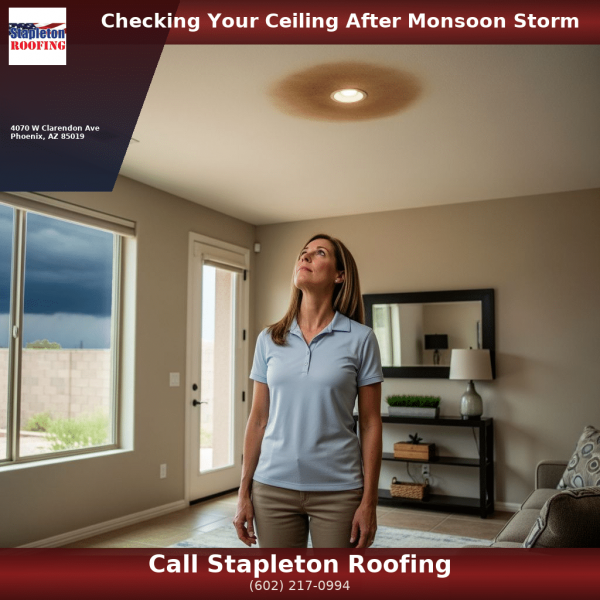
Phoenix homeowner examining ceiling stain after monsoon storm during a post-storm roof inspection

What to Check on Your Phoenix Home’s Roof After a Monsoon Storm

Key Takeaways:

  • After a Phoenix monsoon, check your interior first — ceiling stains, attic odor, and wet window frames can reveal roof damage before you ever step outside.
  • Some of the most serious damage is invisible for 48–72 hours, as saturated underlayment slowly wicks moisture through decking and appears as a new ceiling stain days after the storm.
  • Schedule a professional post-monsoon roof inspection in Phoenix, AZ, before the next storm system arrives — a licensed roofer can detect underlayment saturation, flashing failures, and mortar erosion that no ground-level check can reveal.

Start here: check your ceilings and your attic before you ever open the front door. After a Phoenix monsoon — whether it was a microburst, a haboob trailing rain, or a slow-rolling thunderstorm — the roof damage that matters most often announces itself from the inside first. A post-monsoon roof inspection in Phoenix, AZ, doesn’t require a ladder or a rooftop walk; it requires a flashlight, calm eyes, and a systematic approach.

Here is exactly how to work through it.

Phase 1 — The Interior Check (Do This Immediately After the Storm Passes)

The moment the wind dies down and it is safe to move through your home, start inside. This is the phase most Phoenix homeowners skip, and it is the most important one.

Walk every ceiling in the house. You are looking for any discoloration — yellowish rings, dark patches, or bubbling paint — that was not there before the storm. In a flat or low-slope roof (common across much of Phoenix), water that penetrates the surface membrane pools before it finds a seam, and the ceiling directly below is often the first place it announces itself. Run your hand lightly along any suspect area. If the drywall feels soft or spongy, moisture has already seeped through.

Pay close attention to these specific areas:

  • Window frames and skylights — monsoon winds drive rain horizontally, and any compromised flashing at a skylight curb will push water directly onto the ceiling drywall below.
  • The attic access hatch — if you have pull-down attic stairs or a scuttle hatch, open it and take a slow breath before you climb. A wet-wood or mildew smell tells you moisture has reached the decking or insulation.
  • The attic itself — with your flashlight, look for daylight penetrating through the deck or rafters. Any pinhole of light is a breach. Also look for insulation that appears matted, flattened, or dark, as wet insulation immediately loses its loft.
  • Exterior-facing walls near the roofline — water that enters a compromised rake edge or fascia sometimes runs down the inside of the wall cavity rather than dripping through the ceiling.

Document every finding with a time-stamped photo on your phone. This matters for insurance purposes and for the conversation you will have with your roofer.

Phase 2 — The Safe Ground-Level Exterior Check

Once you are confident the interior is documented, step outside for a ground-level exterior assessment. Do not climb the roof. Phoenix tile and shingle surfaces are extremely slippery after rain, and post-storm debris creates unpredictable hazards. Everything in this phase can be done from your yard, your driveway, and the top two rungs of a stepladder at the gutters — nothing higher.

Walk the full perimeter of your home and look for these visible signs:

  • Tile debris on the ground — broken or whole tiles lying in the yard or landscaping rock mean something shifted or flew free on the roof surface. Even a single displaced tile exposes the underlayment beneath it to the next storm.
  • Ridge cap displacement — stand back far enough from your home to see the roofline silhouette. A ridge cap that has shifted or blown free often shows as an irregular gap or an angled piece sitting where it should be flat.
  • Displaced or lifted shingles on lower slopes — if you have a shingle section visible from ground level or from the second rung of a stepladder, look for shingles that are curled at the corner, visibly darker (indicating trapped moisture below), or simply gone.
  • Gutter and downspout condition — gutters full of granules (the gray-black grit that washes from aging shingle surfaces) suggest significant wear across the field. Bent, detached, or overflowing gutters also indicate that the storm volume exceeded your drainage design.
  • Anything resting against the fascia that wasn’t there before — branches, palm fronds, or debris leaning against the roofline can hold moisture against the fascia board for days, accelerating rot and compromising the drip edge seal.

The Hidden Damage Window: 48–72 Hours After the Storm

This is the section most Phoenix homeowners never read — and it is arguably the most important.

Saturated underlayment does not always produce a visible ceiling stain the same night as the storm. Many roofing systems in Phoenix are built with two to three layers of felt or synthetic underlayment over the decking. When the field membrane takes a hit — a micro-tear from wind-driven debris, or a seam that has been drying and contracting over years of 115°F summers — water slowly enters and saturates the underlayment.

The decking absorbs that moisture. The moisture then wicks downward through the wood fibers. Depending on the decking thickness and the ambient temperature in your attic, it can take 48 to 72 hours for a visible ceiling stain to appear. Homeowners often assume they came through a storm clean because there is no stain the morning after — only to find a new ring on Thursday after a Monday storm.

The lesson: check your ceilings again on day two and day three. Any new stain appearing in that window is almost certainly storm-related and should be treated with the same urgency as one that appeared overnight.

A second hidden failure pattern is mortar erosion at ridge and hip cap seating. FEMA’s building science guidance on wind-driven rain consistently notes that mortar-set cap installations can survive a single storm event even when already compromised — the cap sits in place, appears intact from the ground, and still passes a visual check. However, when the next monsoon adds hydrostatic pressure to a seating that has lost 40% of its mortar coverage, the cap blows free entirely. This is why a professional assessment after every significant storm is not overcautious — it is the only way to catch mortar erosion before the second storm makes it catastrophic.

Phase 3 — What a Professional Post-Storm Inspection Covers That You Cannot See from the Ground

A licensed roofing contractor performing a post-monsoon roof inspection in Phoenix, AZ, will assess four things that are simply not visible or testable from the ground or the interior.

  • Flashing seal verification at all penetrations — every pipe boot, HVAC curb, skylight frame, and chimney base has a flashing seal that degrades under UV and storm pressure. A roofer checks each one for lifting, cracking, or separation that allows water to track under the surface membrane.
  • Underlayment moisture probing — using a non-penetrating moisture meter, a roofer can map wet spots in the decking without cutting into the roof. This identifies saturation zones that have not yet produced a ceiling stain but will.
  • Ridge cap stability testing — each cap is physically assessed for movement and mortar adhesion. A cap that looks perfect from the yard can rock slightly under hand pressure, indicating it is one storm away from displacement.
  • HVAC curb assessment — rooftop air conditioning units are extremely common in Phoenix, and their curb flashings take a direct beating from monsoon wind shear. A curb that has rocked even slightly on its pad breaks the flashing seal on the downwind side.

In 2026, most reputable Phoenix roofing companies will offer post-storm inspections as a standalone service. The inspection itself is often the most valuable $50–$150 you can spend after a major monsoon system — it either confirms your roof is sound or documents damage at the earliest possible moment, before secondary moisture damage compounds the repair cost.

If your interior check turned up a stain, if you found tile on the ground, or if you simply are not sure what that thud was during last night’s storm, schedule a professional assessment before the next weather system rolls through.

Frequently Asked Questions About Post-Monsoon Roof Inspection in Phoenix

How soon after a monsoon storm should I do a post-monsoon roof inspection in Phoenix, AZ?

Start your interior check immediately after the storm passes and it is safe to walk through your home. Follow up with a ground-level exterior check the same day. Because hidden damage can take 48–72 hours to appear as a ceiling stain, recheck your ceilings on day two and day three. Contact a licensed roofing contractor within three to five days of any significant storm — before the next monsoon event arrives — so damage can be documented and addressed while conditions are dry.

A new post-storm ceiling stain typically appears as a yellowish or brownish ring on white drywall, sometimes with a slightly wet or soft center. The key indicator is timing: if the ring was not present before the storm, it is new. Photograph it with a timestamp. Old stains are usually dry and flat to the touch, with a well-defined, darkened outer ring from previous moisture cycling. If you are uncertain, a contractor with a moisture meter can confirm whether the area behind the drywall is currently wet.

No. Wet tile and shingle surfaces are extremely slippery, and post-storm debris on the roof surface creates unpredictable hazards. Everything that can be assessed safely should be done from inside, from the ground, or from the top two rungs of a stepladder at gutter height. A licensed roofer carries fall-protection equipment and has the experience to move safely on wet or debris-covered surfaces. Do not risk a fall for an assessment that a professional can perform more accurately and more safely.

The most frequently identified issues after a Phoenix monsoon are: displaced or cracked tile from wind-driven debris impact, ridge and hip cap displacement caused by wind uplift or mortar erosion, micro-tears in flat roof membrane at seams and penetrations, granule loss on aging shingle fields, gutter separation or overflow damage, and flashing failures at HVAC curbs, skylights, and pipe boots. Older homes — particularly those with roofs more than 15 years old — are statistically more likely to have multiple concurrent issues following a major storm.

Most standard Arizona homeowner’s insurance policies cover sudden and accidental damage caused by wind, hail, and rain — all of which are common in Phoenix monsoon events. However, policies typically exclude damage attributed to deferred maintenance or pre-existing wear. This is one of the most important reasons to schedule a professional inspection promptly: a documented inspection report that ties specific damage to a named storm event provides the strongest foundation for an insurance claim. Contact your insurer to understand your specific deductible and coverage terms before filing.

Sources

  1. FEMA — Building Science Guidance on Wind-Driven Rain and Roof Cap Installations: https://www.fema.gov/emergency-managers/risk-management/building-science/hurricanes
  2. Arizona Department of Insurance and Financial Institutions — Homeowner Insurance Guidance for Storm Claims: https://difi.az.gov
  3. National Roofing Contractors Association (NRCA) — Post-Storm Roof Inspection Best Practices: https://www.nrca.net

Why Trust Stapleton Roofing Company

stapleton roofing crew

Stapleton Roofing Company is a family-owned and locally operated roofing contractor serving homeowners and businesses across Arizona. With more than 40 years of experience, we have earned a reputation as one of the most trusted and respected names in the roofing industry. Our team of licensed, bonded, and insured professionals provides comprehensive roofing services designed for Arizona’s demanding climate—from the intense desert sun to seasonal monsoon rains.

As leading Arizona roof contractors, our mission is simple: deliver honest service, unmatched workmanship, and roofs that stand the test of time. Every project we complete reflects our values—integrity, quality, and safety—and our dedication to customer satisfaction has made us the first choice for thousands of homeowners and businesses statewide.

Our Roofing Services Include:

  • Roof Repair: Leak detection, tile replacement, storm damage repair, and preventative maintenance.
  • Roof Replacement: Full tear-off and installation for shingle, tile, foam, and flat roofing systems.
  • Roof Inspections: Certified inspections for real estate, insurance, and property management.
  • Commercial Roofing: TPO, foam, and flat roofing systems designed for durability and energy efficiency.
  • Residential Roofing: Tile, shingle, and foam roof systems customized for Arizona homes.
  • Roof Coatings & Restoration: Energy-efficient roof coatings that extend the lifespan of your roof.

From our office in Phoenix, Stapleton Roofing Company proudly serves customers across the Greater Phoenix Metro area, including Scottsdale, Glendale, Mesa, Chandler, Surprise, Avondale, Goodyear, Paradise Valley, Cave Creek, Sun City West, and Tempe.

Our team uses only high-quality materials from trusted manufacturers, ensuring that every roofing system we install is built to last and backed by solid warranties. From minor residential repairs to large-scale commercial projects, we approach every job with precision, professionalism, and a no-leak guarantee for the warranty period in your contract.

As active members of the Arizona Roofing Contractors Association (ARCA) and accredited by the Better Business Bureau (BBB), Stapleton Roofing Company continues to set the standard for excellence in the Arizona roofing industry.

Why Homeowners & Businesses Trust Stapleton Roofing Company

  • Family-Owned and Operated
  • Licensed, Bonded, and Insured (ROC #269773)
  • Free Roof Inspections and Honest Estimates
  • Daily Site Cleanup and Safety Protocols
  • Decades of Proven Experience with Arizona Roofs

Business Locations:

Stapleton Roofing Company – Phoenix, AZ
Serving Central Phoenix, Scottsdale, Tempe, Chandler, and Mesa

Stapleton Roofing Company – West Valley Service Area
Serving Peoria, Glendale, Surprise, Avondale, Goodyear, and the West Valley

Facebook
Twitter
LinkedIn
Tumblr
Reddit

Get a Free Roofing Estimate from Stapleton

Ready to secure your home or business with expert roofing services? Contact Stapleton Roofing today for a free, no-obligation estimate on residential or commercial roofing, and ensure your property is protected by the best.

Leave a Reply

Your email address will not be published. Required fields are marked *