What Should You Know About TPO Roofing in Phoenix, AZ?

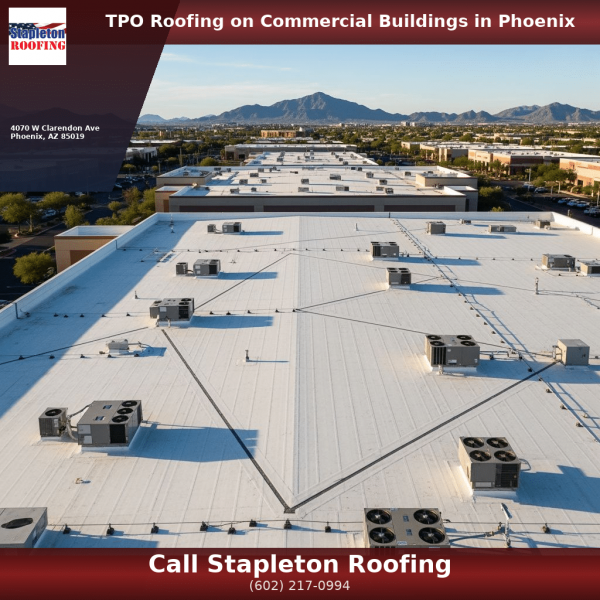
White TPO roofing membrane installed on a commercial flat roof in Phoenix, Arizona, with HVAC units visible

TPO Roofing in Phoenix, AZ: What Commercial Property Owners Need to Know

Key Takeaways:

  • TPO roofing reflects 70–80% of solar radiation, keeping Phoenix commercial roof surfaces 50–60°F cooler than dark membranes — a direct operational cost advantage in Arizona’s extreme heat.
  • Membrane thickness specification (45-mil vs. 60-mil vs. 80-mil) and hot-air weld quality are the two variables that most determine whether a TPO system survives Phoenix’s 50°F+ daily thermal cycles.
  • HVAC curb flashing detail is the number-one source of TPO leaks on Phoenix commercial roofs — any installation evaluation should include a specific review of penetration detailing.

Is TPO roofing good for commercial buildings in Phoenix, Arizona? The direct answer is yes — under the right specification and installation conditions. TPO roofing in Phoenix, Arizona, has become the dominant commercial flat-roof membrane in the market precisely because its reflective white surface combats the Valley’s extreme solar load, and its heat-welded seams accommodate the dramatic daily temperature swings that destroy lesser systems. However, the performance gap between a correctly specified TPO roof and a poorly installed one is wider in Phoenix than in almost any other city in the country.

Why Phoenix’s Climate Makes Membrane Selection So Consequential

Phoenix averages over 300 days of sunshine per year and summer ambient temperatures that regularly exceed 110°F. A dark-membrane roof — aged modified bitumen or EPDM — can reach surface temperatures of 170°F or higher on a peak summer afternoon. That thermal load is transferred directly to the building envelope, stressing HVAC equipment, degrading the insulation R-value over time, and driving up cooling costs.

White TPO reflects 70–80% of solar radiation. Under identical conditions, a properly installed TPO membrane maintains its surface temperature 50–60°F cooler than that of a dark membrane. For a 50,000-square-foot distribution center or retail pad, that differential is not cosmetic — it translates into measurable reductions in cooling demand and longer compressor life for rooftop HVAC units already operating at maximum load for five or more months per year.

Additionally, Phoenix rooftops experience thermal cycling that most other U.S. markets do not. Between a cool desert night and a peak summer afternoon, a commercial roof surface can experience more than 50°F of temperature change in a single day. Over a year, that means hundreds of expansion-and-contraction cycles. A roofing membrane and its seam geometry must absorb that movement without failing.

Membrane Thickness: The Specification Decision That Matters Most

Not all TPO is the same. The industry sells three standard thicknesses — 45-mil, 60-mil, and 80-mil — and, for Phoenix commercial applications, thickness is a critical specification rather than a cost-saving variable.

  • 45-mil TPO carries the lowest upfront cost but the thinnest wear layer. On a Phoenix commercial roof with heavy foot traffic from HVAC maintenance personnel, 45-mil is undersized.
  • 60-mil represents the practical minimum for most Phoenix commercial applications. It offers a substantially thicker wear layer, better puncture resistance, and a wider margin for seam integrity.
  • 80-mil is appropriate for roofs with high HVAC equipment density, frequent maintenance access, or where a 20-year warranty condition is required. The thicker ply also provides a larger seam surface area for the hot-air welder, which improves long-term bond strength in high-thermal-cycling environments.

Facility managers reviewing a TPO bid should confirm which thickness is specified before comparing line-item prices. A 45-mil quote versus an 80-mil quote is not an equivalent proposal, regardless of how the totals appear on paper.

Heat-Weld Seam Quality: Why Phoenix Amplifies Every Installation Error

TPO’s structural integrity lives in its seams. Unlike self-adhered or ballasted membranes, TPO is joined by hot-air welding — a process in which an automated or hand-held welder drives a stream of heated air between two overlapping membrane edges, fusing them into a monolithic bond that, when done correctly, is stronger than the membrane itself.

Phoenix’s thermal cycling exposes every seam imperfection. An under-welded seam — insufficient heat, incorrect travel speed, or inadequate overlap — will begin to peel under repeated stress from expansion and contraction. That separation creates a pathway for water infiltration during monsoon events, which in the Phoenix market means high-intensity, short-duration rainfall that overwhelms any seam gap almost immediately.

Post-installation seam inspection is therefore not optional on a Phoenix project. A qualified contractor will probe test seams with a rounded seam probe immediately after installation and again after the first thermal cycle. Any seam that deflects, opens, or shows a void must be remediated before the roof is considered complete. Ask your contractor whether seam probe testing is included in the project scope — if it is not explicitly stated, add it to the contract.

TPO vs. Spray Polyurethane Foam: Choosing the Right System for Your Property

TPO membrane installation in Phoenix and spray polyurethane foam (SPF) are the two systems that facility managers most frequently compare. They solve different problems, and choosing the wrong one for your building geometry is an expensive mistake.

TPO wins in these scenarios:

  • Large, geometrically simple flat roofs where membrane rolls can be laid with long, uninterrupted seam runs
  • Replacement of existing single-ply systems (EPDM, older TPO) where the substrate is sound and drain locations are correctly placed
  • Properties with complex HVAC layouts requiring precise, code-compliant flashing details that can be inspected and re-flashed individually

SPF wins in these scenarios:

  • Roofs with irregular geometry — multiple levels, numerous curbs, parapets — where cutting and seaming TPO creates a high seam-count risk
  • Existing drain configurations that cannot be relocated and where the current slope is marginal; foam can be tapered in place to improve drainage pitch without tearing out the deck
  • Buildings where improving the roof assembly’s R-value is a priority, since foam adds insulation as it is applied, whereas TPO requires a separate rigid insulation layer beneath the membrane

The honest answer for most large Phoenix commercial roofs — retail, industrial, medical office — is TPO, because those buildings typically have sufficient flat area to make membrane installation efficient and because their HVAC penetration counts, while high, are addressable with proper flashing detail. Smaller, geometrically complex properties benefit from a side-by-side evaluation.

HVAC Penetration Flashing: The Number-One Leak Source on Phoenix Commercial TPO Roofs

Phoenix commercial buildings carry an unusually high density of rooftop HVAC equipment. A 20,000-square-foot office building may have eight to twelve rooftop units, each requiring a curb, a flashing collar, and a membrane termination. Every one of those penetrations is a potential leak point.

Industry data consistently identifies HVAC curb flashing failure as the leading source of TPO roof leaks — not field membrane failure, not seam failure in the open field, but the interface between the TPO membrane and the vertical face of the HVAC equipment curb. This is where water from a Phoenix monsoon storm enters.

Correct detail requires the TPO membrane to wrap up the curb face, terminate at a height that exceeds the expected water ponding level, and be mechanically fastened and sealed with a compatible TPO walkway cover or flashing strip. Uncured TPO flashing — not standard TPO sheet — must be used at inside corners where the flat field meets the vertical curb face. If a contractor is using standard membrane at inside corners, that is a deficiency worth correcting before the job is complete.

Annual Inspection and Warranty Maintenance

Most manufacturer TPO warranties — whether 10, 15, or 20 years — include a maintenance inspection requirement. For Phoenix roofs, an annual inspection, ideally conducted after the monsoon season (September or October), serves two purposes: it satisfies the warranty condition and catches seam separations, flashing lifts, and drainage scuppers that Phoenix weather generates.

Inspection priorities for a Phoenix TPO roof in 2026 include seam probe testing of any seams showing surface discoloration, flashing integrity at all HVAC curbs and penetrations, drain field condition (debris, evidence of ponding), and membrane surface condition for UV degradation or surface crazing. A documented inspection report is the facility manager’s evidence that the warranty condition has been maintained, and it is the first document an insurance adjuster will request after a significant monsoon event.

TPO roofing performs exceptionally well in Phoenix when it is correctly specified, properly installed, and maintained with discipline. The facilities with the worst outcomes are almost always those in which one of the three conditions was not met.

Frequently Asked Questions About TPO Roofing in Phoenix

What membrane thickness should I specify for a Phoenix commercial TPO roof?

For most Phoenix commercial applications, 60-mil is the practical minimum. Roofs with high HVAC equipment density, frequent maintenance foot traffic, or 20-year warranty requirements should specify 80-mil. A 45-mil membrane is undersized for the thermal cycling and foot traffic typical of a Phoenix commercial property.

TPO itself is highly water-resistant, and a properly welded seam is effectively watertight. The risk during monsoon events is not the field membrane — it is HVAC curb flashing details and drain scuppers. If those are correctly installed and maintained, a TPO roof handles Phoenix’s high-intensity monsoon rainfall without issue.

A correctly specified and installed TPO system in Phoenix can perform for 20–25 years with proper annual maintenance. Thinner membranes, poorly welded seams, or neglected HVAC flashing significantly reduce lifespan. Manufacturer warranty terms range from 10 to 20 years, depending on membrane thickness and contractor certification.

Ask whether seam probe testing is included in the project scope. A rounded probe is run along every seam immediately after installation; any seam that opens or shows a void requires re-welding. Additionally, confirm that the contractor uses an automated welder with documented heat and speed settings — hand-welding alone is insufficient for large commercial seam runs.

For a standard strip mall with a geometrically simple flat roof, TPO is generally the better choice because the long membrane runs are efficient to install and HVAC curb flashing — while it requires precise execution — is individually addressable and inspectable. Spray foam is more competitive on properties with complex geometry or where drainage slope improvement is needed without deck reconstruction.

In some cases, yes — but it requires a thorough assessment of the substrate first. The existing membrane must be structurally sound, free of saturated insulation, and compatible with the proposed TPO adhesive or fastener pattern. Phoenix commercial roofs with aged modified bitumen often have moisture-compromised insulation that must be replaced before new TPO is installed, which affects both the project scope and budget.

Sources

  1. Solar reflectance and surface temperature reduction of white roofing membranes — U.S. Department of Energy, Energy Saver: Cool Roofs https://www.energy.gov/energysaver/cool-roofs
  2. TPO roofing membrane standards and performance — Single Ply Roofing Industry (SPRI) https://www.singleply.org
  3. Thermoplastic polyolefin (TPO) — material and application overview — Wikipedia: Thermoplastic Polyolefin https://en.wikipedia.org/wiki/Thermoplastic_polyolefin
  4. Phoenix, Arizona climate data (annual sunshine, temperature extremes) — National Oceanic and Atmospheric Administration (NOAA), Climate Data Online: https://www.ncdc.noaa.gov/cdo-web/

Why Trust Stapleton Roofing Company

stapleton roofing crew

Stapleton Roofing Company is a family-owned and locally operated roofing contractor serving homeowners and businesses across Arizona. With more than 40 years of experience, we have earned a reputation as one of the most trusted and respected names in the roofing industry. Our team of licensed, bonded, and insured professionals provides comprehensive roofing services designed for Arizona’s demanding climate—from the intense desert sun to seasonal monsoon rains.

As leading Arizona roof contractors, our mission is simple: deliver honest service, unmatched workmanship, and roofs that stand the test of time. Every project we complete reflects our values—integrity, quality, and safety—and our dedication to customer satisfaction has made us the first choice for thousands of homeowners and businesses statewide.

Our Roofing Services Include:

  • Roof Repair: Leak detection, tile replacement, storm damage repair, and preventative maintenance.
  • Roof Replacement: Full tear-off and installation for shingle, tile, foam, and flat roofing systems.
  • Roof Inspections: Certified inspections for real estate, insurance, and property management.
  • Commercial Roofing: TPO, foam, and flat roofing systems designed for durability and energy efficiency.
  • Residential Roofing: Tile, shingle, and foam roof systems customized for Arizona homes.
  • Roof Coatings & Restoration: Energy-efficient roof coatings that extend the lifespan of your roof.

From our office in Phoenix, Stapleton Roofing Company proudly serves customers across the Greater Phoenix Metro area, including Scottsdale, Glendale, Mesa, Chandler, Surprise, Avondale, Goodyear, Paradise Valley, Cave Creek, Sun City West, and Tempe.

Our team uses only high-quality materials from trusted manufacturers, ensuring that every roofing system we install is built to last and backed by solid warranties. From minor residential repairs to large-scale commercial projects, we approach every job with precision, professionalism, and a no-leak guarantee for the warranty period in your contract.

As active members of the Arizona Roofing Contractors Association (ARCA) and accredited by the Better Business Bureau (BBB), Stapleton Roofing Company continues to set the standard for excellence in the Arizona roofing industry.

Why Homeowners & Businesses Trust Stapleton Roofing Company

  • Family-Owned and Operated
  • Licensed, Bonded, and Insured (ROC #269773)
  • Free Roof Inspections and Honest Estimates
  • Daily Site Cleanup and Safety Protocols
  • Decades of Proven Experience with Arizona Roofs

Business Locations:

Stapleton Roofing Company – Phoenix, AZ
Serving Central Phoenix, Scottsdale, Tempe, Chandler, and Mesa

Stapleton Roofing Company – West Valley Service Area
Serving Peoria, Glendale, Surprise, Avondale, Goodyear, and the West Valley

Facebook
Twitter
LinkedIn
Tumblr
Reddit

Get a Free Roofing Estimate from Stapleton

Ready to secure your home or business with expert roofing services? Contact Stapleton Roofing today for a free, no-obligation estimate on residential or commercial roofing, and ensure your property is protected by the best.

Leave a Reply

Your email address will not be published. Required fields are marked *