What Should You Know About Roofing in Glendale, AZ?

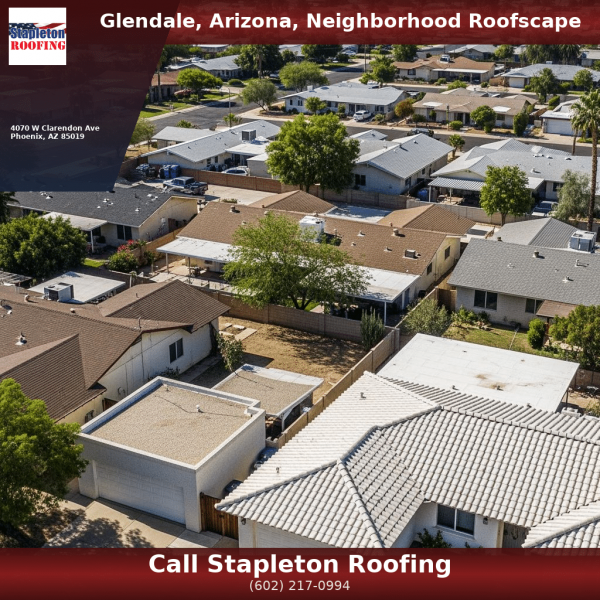
Glendale AZ neighborhood roofscape showing mix of tile and shingle roofs on residential homes

Roofing in Glendale, AZ: What Homeowners Need to Know Before Repair or Replacement

Key Takeaways:

  • Glendale’s diverse housing stock — from 1920s Catlin Court bungalows to Arrowhead Ranch tile communities — means roofing decisions depend heavily on your neighborhood’s era and material.
  • The repair vs replacement decision changes dramatically at the 20-year threshold, and flat or low-slope sections over garages often fail independently of your main pitched roof.
  • Stapleton Roofing Company is a locally rooted, family-owned, ROC-licensed Glendale contractor offering free estimates and rapid post-monsoon response throughout the area.

Glendale homeowners face a roofing market that is more complicated than the metro-wide average suggests. Your neighborhood’s decade of construction, the mix of pitched and flat sections on your home, and the timing of the last monsoon season all shape what your roof actually needs — and what it will cost. Before you accept a bid or sign a contract, here is what the local picture really looks like.

Glendale’s Housing Stock Is Older — and More Varied — Than Most Contractors Admit

Spend an afternoon driving through different Glendale neighborhoods, and the generational variation becomes obvious. Catlin Court, one of the city’s historic districts, contains craftsman bungalows and Period Revival homes built from the 1920s through the 1960s. Many of those roofs have been replaced at least once, but replacement cycles vary — a home in that district could be sitting on a shingle roof installed in the late 1990s or early 2000s that is now approaching the end of its typical 20–25-year service life.

Move south toward the Sahuaro District, and the character shifts. Mid-century ranch homes built between the 1950s and 1970s dominate those streets. These homes frequently feature low-slope or flat roof sections — particularly over room additions, attached garages, and covered patios that were enclosed decades ago. That flat section often carries a built-up roofing membrane or a modified bitumen layer installed at a different time than the main pitched roof. The two systems age on separate timelines, which creates a trap: a general roof inspection might report the pitched shingles as serviceable while overlooking a failing flat membrane.

Then there is Arrowhead Ranch in northwest Glendale — a master-planned community where concrete tile is the dominant roofing material and HOA architectural review boards govern what replacement materials and colors are acceptable.

Homes built before 1985 are statistically more likely to be approaching or past the end of their roofing system’s original design life. If your home falls in that category, the question is rarely “Does my roof need attention?” It is almost always “How much attention, and in what order?”

Repair vs. Replacement: The Thresholds That Actually Matter in Glendale

The repair-or-replace decision is not purely about visible damage. Age, material, and the scope of underlying problems all shift the calculus — sometimes dramatically.

For pitched shingle roofs, the 20-year mark is a meaningful inflection point. For those under 15 years of age, spot repairs for isolated storm damage or flashing failures are almost always the right call. Between 15 and 20 years, the answer depends on the scope of the problem and the condition of the underlayment. Above 20 years, a repair that extends the roof’s life by three to five years often costs nearly as much as putting that money toward a full replacement — and delivers far less certainty.

For concrete tile roofs common in Arrowhead Ranch and similar communities, the arithmetic is different. Tile itself can last 40–50 years, but the underlayment beneath it typically reaches the end of its life after 20-30 years. A roof that looks fine from the street may have compromised underlayment that will allow water intrusion the next time a monsoon cell drops three inches of rain in forty-five minutes. In that scenario, a “repair” means removing and reinstalling tile over new underlayment — a job that approaches full re-roof cost and scope.

The flat section question deserves its own honest conversation. Many Glendale homeowners do not realize their home has two separate roofing systems until a contractor points to the garage or the room addition. Flat and low-slope membranes fail through:

  • Ponding water that accelerates membrane degradation
  • UV breakdown from Glendale’s intense sun exposure
  • Seam and flashing separations caused by thermal cycling
  • Improper drainage slope installed in the original construction

A flat membrane failure can occur completely independently of the pitched portion of your roof. If a home inspector flagged both systems in their report, treat them as separate line items with distinct urgency levels — the flat section may need immediate attention, while the tile-pitched section still has years of service life remaining.

Why a Locally Rooted Glendale Contractor Changes the Outcome

A Phoenix metro contractor who services Glendale occasionally is not the same as a contractor who works here consistently. The differences show up in ways homeowners do not always anticipate.

Post-monsoon response time is one of the most practical. When a storm cell tracks through the West Valley and produces widespread hail or wind damage across Glendale in a single afternoon, the response window from a locally based crew is genuinely faster. Emergency tarping, damage documentation for insurance claims, and priority scheduling all depend on proximity and crew availability in the immediate area — not on a dispatch board managing the entire metro.

Permit history and older records matter here too. Glendale’s building department maintains permit records, but navigating those records for a 1958 ranch home with multiple additions requires familiarity with how the city’s historical documentation is organized. A contractor who regularly pulls permits with the City of Glendale Building Safety division knows what documentation is required up front, which prevents delays that add weeks to a project timeline.

HOA requirements in Arrowhead Ranch and similar planned communities add another layer. Acceptable tile profiles, color palettes, and manufacturer specifications are often specified in the community’s CC&Rs. A contractor who has navigated that review process before can guide you through the approval submission correctly the first time — avoiding a rejected application and a restart.

Finally, there is the practical knowledge that accumulates from working in a specific city over time: which neighborhoods have chronic drainage problems that affect flat roof performance, which older subdivisions use non-standard deck configurations, and which material suppliers can source matching tile for a partial tile repair in an Arrowhead Ranch community rather than requiring a full replacement to achieve color consistency.

What to Expect From the Estimate Process

A legitimate roofing estimate in Glendale should include a physical inspection — not just a drive-by assessment or a satellite image review. The contractor should document both the pitched and flat sections of your roof, note the age and condition of the underlayment, if visible, check the flashing at penetrations and transitions, and inspect the gutters and fascia for signs of long-term water intrusion.

In 2026, Glendale homeowners will have real leverage in the bidding process. Three competitive bids are a reasonable baseline. Ask each contractor to break out labor, materials, and disposal separately — it makes comparison meaningful rather than just comparing totals.

Stapleton Roofing Company: Glendale’s Family-Owned Roofing Authority

Stapleton Roofing Company is a family-owned, ROC-licensed residential roofing contractor serving Glendale homeowners across every era of the city’s housing stock — from Catlin Court historic bungalows to Arrowhead Ranch tile communities and the mid-century ranch homes of the Sahuaro District. The company offers free, no-pressure estimates and carries the licensing and local experience that Glendale’s varied neighborhoods demand.

If your roof is showing its age, an inspector flagged concerns, or the last monsoon left you uncertain about what comes next, reach out to Stapleton Roofing Company for a thorough inspection and honest assessment of your options.

Frequently Asked Questions About Roofing in Glendale, AZ

How do I know if my Glendale home needs roof repair or full replacement?

Age and scope of damage are the primary factors. Shingle roofs under 15 years old with isolated damage typically warrant repair. Roofs over 20 years old, or those with widespread granule loss and underlayment degradation, usually make more financial sense to replace in full. A physical inspection by a qualified contractor is the only reliable way to determine which category your roof falls into.

Yes. Monsoons in Glendale produce a combination of high winds, sudden heavy rainfall, and sometimes hail — each of which can create distinct failure modes. Wind lifts shingles and tile at ridges and edges. Heavy rainfall overwhelms flat and low-slope membrane drainage, accelerating ponding damage. Hail can bruise shingles and crack concrete tile. Post-storm inspections should check all three damage types, not just the most visible one.

Arrowhead Ranch and similar master-planned Glendale communities typically require concrete tile in specific profiles and color ranges approved by the HOA architectural review board. Before selecting a material or manufacturer, confirm the exact specifications with your HOA and verify that your contractor has previously submitted approval documentation for that community. Using an unapproved product may result in required removal at the homeowner’s expense.

Permit timelines vary by project scope and the city’s current workload. A straightforward residential re-roof typically processes within a few business days to two weeks through the City of Glendale Building Safety Division. Projects involving structural changes, additions, or historic district properties may take longer. A contractor who regularly pulls permits in Glendale will have a realistic timeline estimate based on current processing cycles.

Completely normal. Flat and low-slope roof sections use different materials and have different service lives than pitched tile sections. The membrane on a flat garage roof may reach the end of its life in 15–20 years, while the concrete tile on the adjacent pitched section still has decades of life remaining. Treating them as separate systems — with separate inspection, maintenance, and replacement schedules — is the correct approach.

Ask for their ROC license number and verify it through the Arizona Registrar of Contractors. Confirm they carry general liability and workers’ compensation insurance. Request a written scope of work that separates labor, materials, and disposal. Ask specifically about their experience with your roof type — shingle, tile, or flat — and whether they handle HOA approval submissions if applicable. Finally, ask about their post-installation warranty terms and what they cover.

Glendale’s combination of intense UV exposure and extreme thermal cycling — temperatures swinging dramatically between summer highs and winter lows — accelerates the degradation of underlayment, sealants, and flashing materials more quickly than in cooler climates. Organic-based materials break down more quickly. Concrete tile performs well in this environment, which is one reason it became dominant in Glendale’s newer communities. For shingle roofs, Class 4 impact-resistant and reflective shingles can extend service life and reduce heat transfer into the home.

Sources

  1. Typical asphalt shingle roof service life (20–25 years) — U.S. Department of Energy, Office of Energy Efficiency & Renewable Energy: https://www.energy.gov/energysaver/roofing
  2. City of Glendale building permits and application process — City of Glendale Building Safety Division: https://www.glendaleaz.com/services/permits_and_licenses/building_permits
  3. Arizona Registrar of Contractors license verification — Arizona Registrar of Contractors: https://roc.az.gov

Why Trust Stapleton Roofing Company

stapleton roofing crew

Stapleton Roofing Company is a family-owned and locally operated roofing contractor serving homeowners and businesses across Arizona. With more than 40 years of experience, we have earned a reputation as one of the most trusted and respected names in the roofing industry. Our team of licensed, bonded, and insured professionals provides comprehensive roofing services designed for Arizona’s demanding climate—from the intense desert sun to seasonal monsoon rains.

As leading Arizona roof contractors, our mission is simple: deliver honest service, unmatched workmanship, and roofs that stand the test of time. Every project we complete reflects our values—integrity, quality, and safety—and our dedication to customer satisfaction has made us the first choice for thousands of homeowners and businesses statewide.

Our Roofing Services Include:

  • Roof Repair: Leak detection, tile replacement, storm damage repair, and preventative maintenance.
  • Roof Replacement: Full tear-off and installation for shingle, tile, foam, and flat roofing systems.
  • Roof Inspections: Certified inspections for real estate, insurance, and property management.
  • Commercial Roofing: TPO, foam, and flat roofing systems designed for durability and energy efficiency.
  • Residential Roofing: Tile, shingle, and foam roof systems customized for Arizona homes.
  • Roof Coatings & Restoration: Energy-efficient roof coatings that extend the lifespan of your roof.

From our office in Phoenix, Stapleton Roofing Company proudly serves customers across the Greater Phoenix Metro area, including Scottsdale, Glendale, Mesa, Chandler, Surprise, Avondale, Goodyear, Paradise Valley, Cave Creek, Sun City West, and Tempe.

Our team uses only high-quality materials from trusted manufacturers, ensuring that every roofing system we install is built to last and backed by solid warranties. From minor residential repairs to large-scale commercial projects, we approach every job with precision, professionalism, and a no-leak guarantee for the warranty period in your contract.

As active members of the Arizona Roofing Contractors Association (ARCA) and accredited by the Better Business Bureau (BBB), Stapleton Roofing Company continues to set the standard for excellence in the Arizona roofing industry.

Why Homeowners & Businesses Trust Stapleton Roofing Company

  • Family-Owned and Operated
  • Licensed, Bonded, and Insured (ROC #269773)
  • Free Roof Inspections and Honest Estimates
  • Daily Site Cleanup and Safety Protocols
  • Decades of Proven Experience with Arizona Roofs

Business Locations:

Stapleton Roofing Company – Phoenix, AZ
Serving Central Phoenix, Scottsdale, Tempe, Chandler, and Mesa

Stapleton Roofing Company – West Valley Service Area
Serving Peoria, Glendale, Surprise, Avondale, Goodyear, and the West Valley

Facebook
Twitter
LinkedIn
Tumblr
Reddit

Get a Free Roofing Estimate from Stapleton

Ready to secure your home or business with expert roofing services? Contact Stapleton Roofing today for a free, no-obligation estimate on residential or commercial roofing, and ensure your property is protected by the best.

Leave a Reply

Your email address will not be published. Required fields are marked *