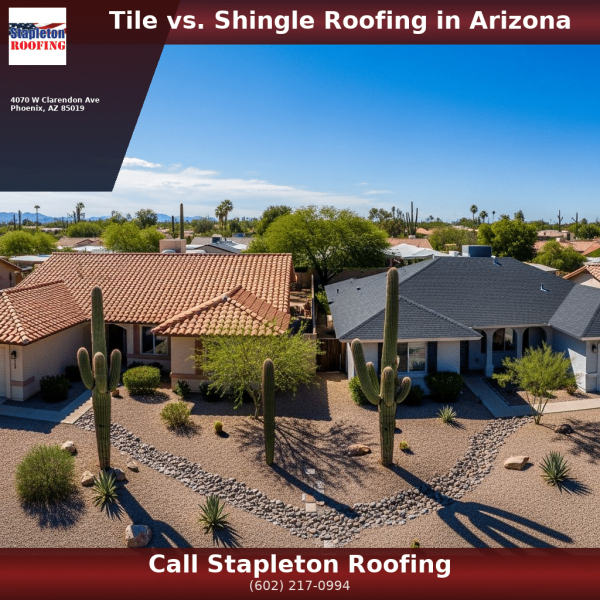
Tile vs. Shingle Roofing in Arizona: Which Is Right for Your Phoenix Home?
Key Takeaways:
- Clay tile roofs last 50+ years in Arizona’s desert climate, while architectural shingles typically need replacement every 15–20 years in Phoenix heat — making the lifetime cost comparison less obvious than the upfront price tag suggests.
- Tile’s air-gap design keeps attics cooler, but it adds significant weight that requires structural verification before a reroof; shingles are lighter, faster to install, and better suited to low-pitch roofs.
- The right choice depends on your budget, timeline, HOA rules, roof pitch, and how long you plan to stay in the home — a free estimate from Stapleton Roofing Company includes a side-by-side analysis of both options for your specific house.
Your roof bids are sitting on the kitchen table. One contractor quoted clay tile. Another quoted architectural shingles. The prices are different, the warranties are different, and now you are wondering whether the cheaper option is actually cheaper — or whether you will be back on the phone with a roofer in fifteen years doing this all over again.
That question deserves a straight answer. After four decades of installing both systems across the Valley, here is what Phoenix homeowners genuinely need to weigh before they sign anything.
How Arizona’s Climate Changes the Entire Calculation
Most roofing comparisons you find online are written for the Pacific Northwest or the Midwest. Phoenix is a different animal entirely. Summer temperatures regularly exceed 110°F, UV radiation is relentless, and monsoon season delivers sudden high-wind, high-moisture events between June and September.
Those conditions affect tile and shingles very differently.
Clay and concrete tile roofs are engineered for exactly this environment. The barrel or S-curve profile of a clay tile creates an air gap between the tile surface and the roof deck below. That gap allows heat to dissipate rather than transfer directly into your attic. According to the U.S. Department of Energy, reducing attic heat gain is one of the most effective strategies for lowering cooling costs in hot climates — and tile’s natural convection effect does exactly that.
Asphalt shingles, by contrast, absorb UV radiation directly. A dark or medium-tone shingle surface can reach surface temperatures above 150°F on a Phoenix summer afternoon. Even cool-roof shingle products, which use reflective granules, perform meaningfully below tile in sustained high-heat conditions.
Lifespan follows the same pattern. Architectural shingles are typically rated for 25–30 years under standard conditions, but Phoenix’s heat accelerates granule loss and binder degradation. A realistic service life for architectural shingles in the Valley runs closer to 15–20 years. Quality clay tile, properly installed, routinely reaches 50 years or more. Concrete tile falls in the 30–50-year range depending on the product and maintenance history.
The “Shingles Are Cheaper” Myth Deserves a Closer Look
This is the most common misconception homeowners bring to a roofing estimate. Shingles do cost less upfront — typically $4–$7 per square foot installed for architectural shingles versus $10–$20 or more per square foot for clay tile, depending on material and roof complexity. That gap is real.
However, the math changes when you factor in replacement cycles. A homeowner who installs shingles on a Phoenix home at age 50 will likely replace that roof again around age 65–70. A homeowner who installs clay tile at the same time may never replace the field tile during their ownership. When you calculate two or three shingle roof replacements against one tile installation over a 40–50-year horizon, the total cost of ownership often favors tile — especially when labor costs continue to rise.
There is also an insurance angle worth exploring. Some carriers in Arizona offer premium credits or preferred underwriting for tile roofs because of their longer lifespan and Class A fire rating. Ask your insurance agent directly before you finalize your material choice. The savings over a decade can be meaningful.
Weight is the honest counterargument. Clay tile weighs approximately 900–1,200 pounds per roofing square (100 square feet). Concrete tile runs 900–1,100 pounds per square. Most Phoenix-area homes built after the mid-1980s were engineered to carry that load, but older homes — particularly wood-frame construction from the 1960s and 1970s — may require structural reinforcement before a tile reroof. A legitimate contractor will pull your original building plans or conduct a load-path assessment before quoting tile. If a bidder skips that step, that is a red flag.
When Shingles Are Actually the Right Answer
Tile is not always the better choice. There are genuine situations where shingles make more sense for a Phoenix homeowner:
- Budget constraints are real. If cash flow or financing limits your upfront spend, quality shingles installed correctly are far superior to poorly installed tile or to tile chosen by sacrificing other critical repairs.
- HOA restrictions sometimes dictate color ranges, profiles, or material types that eliminate certain tile options — or that require a specific aesthetic that shingles can match more flexibly.
- Low-pitch roofs create drainage challenges for tile. Most clay and concrete tile systems require a minimum pitch of 3:12 to drain properly. Roofs with 2:12 or lower slopes are typically better served by modified bitumen, TPO, or sometimes a quality asphalt shingle with proper underlayment — not tile.
- Short ownership horizons change the math. If you plan to sell the home within five to seven years, the upfront cost differential may not be recovered in resale value, depending on your neighborhood’s price range and buyer expectations.
There is also a category in between: high-quality polymer-composite tiles that mimic the profile of clay tile at a lower weight and mid-range cost. These products have improved considerably in 2026 and represent a genuine middle-ground option worth discussing if you love the look of tile but are constrained by structural or budget constraints.
Monsoon Season: What Each System Handles Well and Where Each Has Vulnerabilities
Monsoon season is when installation quality matters as much as material choice. Both systems have distinct exposure points.
Tile ridge caps — the individual pieces that cap the peak of a barrel tile roof — are vulnerable to wind uplift if they were set in mortar that has dried out and cracked over the years. Re-bedding and repointing of ridge caps every 10–15 years help keep this risk under control. This is routine maintenance, not a design flaw.
Shingles carry their own monsoon risk. Wind-uplift at the eaves and rakes is the most common failure point, especially on older installations where the starter course was omitted or adhesive strips have delaminated. In a severe monsoon event, a shingle roof that was not installed with full perimeter sealing is more likely to lose material than a properly maintained tile roof.
The honest takeaway: neither system is maintenance-free in the Valley. What changes between them is the nature of the maintenance and how frequently it is needed.
What a Stapleton Roofing Estimate Actually Covers
A free estimate from Stapleton Roofing Company is not a number on a piece of paper. For homeowners comparing tile and shingle options, the estimate process includes a physical inspection of your current roof deck and structure, a review of your attic access point to assess load-bearing capacity, and a side-by-side written comparison of both material paths with projected costs, expected service life in Phoenix conditions, and any structural considerations that apply to your specific home.
You leave with enough information to make a confident decision — not a sales pitch for whichever material carries a higher margin that month.
The honest answer to tile versus shingles is that it depends on your home, your budget, your timeline, and your tolerance for upfront cost versus long-term value. What should not vary is the quality of the information you receive before you decide.
Frequently Asked Questions About Tile vs. Shingle Roofing in Arizona
How long do shingles actually last on a Phoenix roof?
Architectural shingles rated for 25–30 years under standard conditions typically perform for 15–20 years in Phoenix’s high-UV, high-heat environment. Premium shingle products with enhanced granule coating can approach the 20-year mark, but Phoenix homeowners should plan for a shorter service life than the manufacturer’s nominal rating suggests.
Do I need a structural inspection before switching from shingles to tile?
Yes — always. Clay tile weighs roughly 900–1,200 pounds per roofing square, compared to approximately 200–300 pounds per roofing square for architectural shingles. Switching from shingles to tile without verifying your roof structure’s load capacity is a serious safety risk and may violate local building codes. A reputable contractor will assess this before quoting.
Can I install tile on a low-pitch roof?
Most clay and concrete tile systems require a minimum pitch of 3:12 for adequate drainage. Roofs with slopes below that threshold are generally not suitable for standard tile systems without engineered drainage solutions, and even then, alternatives like TPO or modified bitumen are often a more practical fit. Discuss your specific pitch with a licensed roofing contractor.
Does tile actually lower my energy bills in Arizona?
Tile’s air-gap design reduces heat transfer to the roof deck, which can meaningfully lower attic temperatures and reduce cooling loads. The exact savings depend on your attic insulation levels, HVAC system efficiency, and home orientation. Combined with radiant barrier decking and proper attic ventilation, a tile roof can contribute to noticeable reductions in summer cooling costs.
Will my insurance company charge less if I choose tile?
Some Arizona homeowners insurance carriers offer premium credits or preferred underwriting for tile roofs because of their longer lifespan and fire resistance rating. This is not universal — it depends on your specific carrier and policy. Ask your insurance agent directly before finalizing your material choice, and request the comparison in writing.
What is the typical cost difference between tile and shingles in Phoenix?
As a general range, architectural shingles in the Phoenix market typically run $4–$7 per square foot installed, while clay tile ranges from $10–$20 per square foot or more, depending on material grade, roof complexity, and structural requirements. These are ballpark figures — your actual quote will vary based on your specific home, current material costs, and labor rates in 2026.
How often does tile require maintenance on a Phoenix roof?
Tile field units are highly durable and rarely require replacement except in cases of impact damage. The primary maintenance item is ridge cap mortar, which should be inspected and re-bedded approximately every 10–15 years. Flashing around penetrations and the perimeter seal at the eaves are also points of periodic maintenance. Overall, tile requires less frequent intervention than shingles over a 30–50-year span.
Sources
- Heat transfer and attic cooling in hot climates — U.S. Department of Energy, Energy Saver: https://www.energy.gov/energysaver/radiant-barriers
- Cool roofing materials and reflective properties — Cool Roof Rating Council: https://www.coolroofs.org/resources/roofing-materials
- Arizona monsoon climate data and seasonal weather patterns — National Weather Service Phoenix: https://www.weather.gov/psr/Monsoon
Why Trust Stapleton Roofing Company
Stapleton Roofing Company is a family-owned and locally operated roofing contractor serving homeowners and businesses across Arizona. With more than 40 years of experience, we have earned a reputation as one of the most trusted and respected names in the roofing industry. Our team of licensed, bonded, and insured professionals provides comprehensive roofing services designed for Arizona’s demanding climate—from the intense desert sun to seasonal monsoon rains.
As leading Arizona roof contractors, our mission is simple: deliver honest service, unmatched workmanship, and roofs that stand the test of time. Every project we complete reflects our values—integrity, quality, and safety—and our dedication to customer satisfaction has made us the first choice for thousands of homeowners and businesses statewide.
Our Roofing Services Include:
- Roof Repair: Leak detection, tile replacement, storm damage repair, and preventative maintenance.
- Roof Replacement: Full tear-off and installation for shingle, tile, foam, and flat roofing systems.
- Roof Inspections: Certified inspections for real estate, insurance, and property management.
- Commercial Roofing: TPO, foam, and flat roofing systems designed for durability and energy efficiency.
- Residential Roofing: Tile, shingle, and foam roof systems customized for Arizona homes.
- Roof Coatings & Restoration: Energy-efficient roof coatings that extend the lifespan of your roof.
From our office in Phoenix, Stapleton Roofing Company proudly serves customers across the Greater Phoenix Metro area, including Scottsdale, Glendale, Mesa, Chandler, Surprise, Avondale, Goodyear, Paradise Valley, Cave Creek, Sun City West, and Tempe.
Our team uses only high-quality materials from trusted manufacturers, ensuring that every roofing system we install is built to last and backed by solid warranties. From minor residential repairs to large-scale commercial projects, we approach every job with precision, professionalism, and a no-leak guarantee for the warranty period in your contract.
As active members of the Arizona Roofing Contractors Association (ARCA) and accredited by the Better Business Bureau (BBB), Stapleton Roofing Company continues to set the standard for excellence in the Arizona roofing industry.
Why Homeowners & Businesses Trust Stapleton Roofing Company
- Family-Owned and Operated
- Licensed, Bonded, and Insured (ROC #269773)
- Free Roof Inspections and Honest Estimates
- Daily Site Cleanup and Safety Protocols
- Decades of Proven Experience with Arizona Roofs
Business Locations:
Stapleton Roofing Company – Phoenix, AZ
Serving Central Phoenix, Scottsdale, Tempe, Chandler, and Mesa
Stapleton Roofing Company – West Valley Service Area
Serving Peoria, Glendale, Surprise, Avondale, Goodyear, and the West Valley