Phoenix Commercial Roofing: 5 Questions to Ask

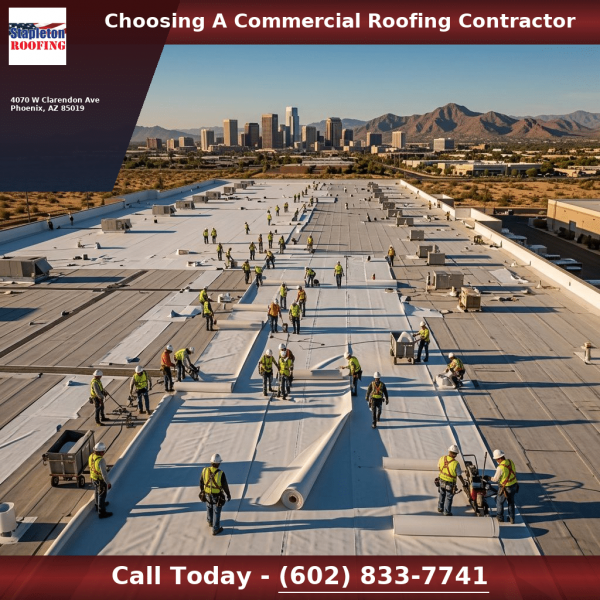
Commercial roofing crew installing a roofing system on a building

5 Critical Questions Every Phoenix Business Owner Should Ask Before Choosing a Commercial Roofing Contractor

Key Takeaways:

  • Arizona’s extreme heat cycles, monsoon patterns, and UV intensity demand a commercial roofing contractor with deep, Phoenix-specific experience — not just a large portfolio from other climates.
  • Material selection between foam, TPO, and traditional systems should be driven by your building’s specific use, age, and desert exposure — a qualified contractor helps you choose based on data, not upselling.
  • Verifying ROC license history, commercial specialization, and local references is the most reliable way to separate genuinely experienced contractors from well-marketed ones.

Your commercial roof is one of the largest single investments protecting your business. Choosing the wrong contractor doesn’t just cost money — it costs time, productivity, and sometimes tenants. Before you sign anything, these five questions will help you separate genuinely qualified contractors from well-marketed ones.

Why Arizona-Specific Experience Matters More Than National Recognition When Choosing a Commercial Roofing Contractor

A contractor who has successfully roofed warehouses in Seattle, Denver, and Atlanta may still be dangerously unprepared for Phoenix.

The Sonoran Desert creates conditions that simply do not exist in most U.S. markets. Roof surface temperatures regularly exceed 170°F. Monsoon season delivers violent wind-driven rain after months of bone-dry heat — a rapid shift that stresses every seam, membrane, and fastener. UV intensity in Phoenix degrades roofing materials faster than in virtually any other American city.

A contractor who spent decades solving roofing problems in a cooler, wetter climate has not built the pattern recognition your building requires. Conversely, a contractor with 20, 30, or 40 years of service in greater Phoenix has seen how different materials respond over hundreds of heat cycles. They have watched which foam formulations hold up and which ones chalk and crack. They know which drainage designs fail during the August storms.

Ask specifically: How many years has your team been working on commercial roofs in Phoenix, not just in business generally? The answer reveals whether their knowledge is transferable or genuinely local.

Stapleton Roofing Company, licensed under ROC 269773, has been serving the greater Phoenix area for 40 years — a depth of Arizona-specific experience that directly shapes every recommendation the team makes.

For further context on how climate drives roofing material selection, the National Roofing Contractors Association publishes regional guidance that underscores the importance of local expertise.

The Foam vs. TPO vs. Traditional Debate: What Works Best in the Sonoran Desert

Most Phoenix commercial property owners have heard the acronyms — foam, TPO, EPDM, modified bitumen — but few have received a clear, unbiased explanation of what each means for their specific building.

Spray Polyurethane Foam (SPF) creates a seamless, monolithic surface with no joints or seams to fail. Because it is applied as a liquid and expands to fill every contour, it eliminates the most common failure points on aging flat roofs. Foam also delivers exceptional insulation value, which matters significantly in a climate where cooling costs dominate operating budgets. However, foam requires skilled application and a proper protective coating — poorly applied foam degrades quickly in intense UV environments. Learn more about our foam roofing services and how they are engineered for Phoenix conditions.

TPO (Thermoplastic Polyolefin) has become the dominant choice for new commercial construction. It reflects solar radiation effectively, resists puncture well, and heat-welded seams — when done correctly — create strong, durable bonds. TPO performs particularly well on large, unobstructed roof decks common in retail and industrial buildings across Phoenix.

Modified bitumen and built-up systems remain appropriate for certain older commercial buildings, especially when structural limitations make a full tear-off impractical.

The right answer for your building depends on its age, deck condition, drainage design, occupancy type, and budget. Any contractor who recommends a specific system before conducting a thorough inspection is working from a sales script, not a professional assessment.

Ask: Can you walk me through why you’re recommending this system over the alternatives for my specific building? A confident, data-driven answer indicates expertise. Vague generalities indicate the opposite.

The U.S. Department of Energy provides independent research on reflective roofing performance that is worth reviewing before any commercial roof decision.

How to Verify True Commercial Specialization vs. Mixed Residential Focus

Size is not the same as specialization. Some of the largest roofing companies in Phoenix spend most of their labor hours in residential neighborhoods — tile reroof after tile reroof — with a small commercial division handling overflow work.

Commercial roofing is a genuinely different discipline. The equipment is heavier. The project management is more complex. OSHA fall protection requirements for flat commercial roofs differ from those for pitched residential work. Multi-phase scheduling around tenant occupancy, loading dock access, and business hours requires a project management capability that purely residential crews rarely develop.

Ask: What percentage of your annual revenue comes from commercial work versus residential? A contractor who cannot answer this confidently — or who pivots quickly to project count rather than revenue — may be telling you something important without saying it directly.

Also, ask for references specifically from commercial projects of similar scope and building type. A restaurant roof and a 50,000-square-foot distribution center are not comparable experiences. You want references that match your situation.

Explore our commercial roofing services to understand the range of commercial work our team specializes in across the Phoenix metro area.

The ROC License Deep Dive: What Those Numbers Really Tell You When Choosing a Commercial Roofing Contractor

Arizona’s Registrar of Contractors — commonly called the ROC — is one of your most powerful verification tools, and most property owners never use it fully.

Every licensed contractor in Arizona has a publicly searchable ROC number. Looking up that number takes less than two minutes and reveals far more than you might expect: license issue date, license status, any complaints filed, and disciplinary actions taken.

When evaluating any commercial roofing contractor, search their ROC number at roc.az.gov before scheduling an inspection. Look for:

  • License issue date — this tells you when the business was formally established in Arizona, not just when they started advertising locally.
  • Active status — an expired or suspended license is an immediate disqualifier.
  • Complaint history — a handful of resolved complaints on a 40-year license record tells a very different story than unresolved complaints on a 5-year one.
  • License classification — verify it covers the type of commercial work your project requires.

Stapleton Roofing Company holds ROC license 269773. You can verify this record directly through the Arizona ROC website. That transparency is exactly what you should expect from any contractor seeking your business.

Ask: What is your ROC number, and what is your complaint history? A contractor who hesitates to answer either part of that question has given you important information.

When ‘Established Since’ Dates Actually Matter for Your Building’s Future

“Family-owned since [year]” appears in nearly every roofing contractor’s marketing. The question is whether those years represent accumulated Arizona-specific expertise or simply time in business.

Longevity matters most in two specific scenarios. First, warranty fulfillment. A 20-year manufacturer warranty on your TPO system is only as reliable as the contractor who installs it. Contractors who have been installing commercial roofs in Phoenix for decades are far more likely to be operating — and standing behind their work — five, ten, or fifteen years from now than a newer entrant.

Second, institutional knowledge. A contractor who has been maintaining the same commercial roof for 15 years understands its specific quirks, past repairs, and vulnerability points in ways that no inspection report can fully capture. That continuity reduces risk and reduces cost over a building’s lifetime.

In 2026, with material costs elevated and commercial construction timelines stretched, the real value of an experienced Phoenix contractor is their ability to anticipate problems before they become emergencies. That knowledge is not something a newer company can shortcut or purchase.

Ask: Can you show me examples of commercial relationships you’ve maintained for ten years or more in Phoenix? Long-term commercial clients are the clearest proof that a contractor’s work holds up — and that their business does too.

Browse our project history to see the range of commercial work our team has completed across the Phoenix area. You can also contact our team to discuss your building’s specific needs.

For a broader framework on evaluating contractor qualifications, the Better Business Bureau’s contractor selection guide offers practical, vendor-neutral guidance.

Frequently Asked Questions About Choosing a Commercial Roofing Contractor

How many years of Phoenix-specific experience should a commercial roofer have?

Look for contractors with at least 20 years of experience exclusively serving the Phoenix market. This threshold ensures they have seen multiple monsoon seasons, heat expansion cycles, and the full lifecycle of the materials they recommend. Experience in other climates does not substitute for local pattern recognition.

TPO offers strong puncture resistance, excellent solar reflectivity, and heat-welded seam strength — making it particularly effective on large commercial roof decks. Foam provides a seamless, monolithic surface with superior insulation value and the ability to conform to irregular roof geometry. Both systems are well-suited to desert conditions when properly selected and installed by experienced applicators.

Commercial roofing requires specialized equipment, different crew training, and project management capabilities that differ significantly from those for residential work. Dedicated commercial specialists typically deliver more consistent outcomes on business properties. A mixed contractor is not automatically disqualified, but you should verify that commercial work represents a substantial, intentional part of their business — not an occasional sideline.

Check their ROC license history at roc.az.gov, which shows the license issue date, current status, and any complaints or disciplinary actions. Ask for references from commercial projects of similar scope and building type in Phoenix. Finally, ask direct questions about Arizona-specific challenges — how they address monsoon drainage, thermal expansion, and UV coating selection. Confident, specific answers indicate genuine expertise.

Ask whether the warranty is a manufacturer’s warranty, a workmanship warranty, or both — and what each covers. Confirm that the contractor is an approved installer for the manufacturer’s warranty they’re offering, since unapproved installation typically voids coverage. Also, ask how long the contractor has been in business, because a 20-year warranty is only meaningful if the company will still exist to honor it.

Phoenix monsoon storms deliver high-velocity, wind-driven rain after extended dry periods. This creates unique stress on seams, edges, and penetrations that have expanded and contracted through months of extreme heat. Systems with fewer seams — like spray foam — reduce vulnerability to this pattern. However, all commercial systems require proper drainage design and edge detailing to manage sudden high-volume water flow. Any contractor who doesn’t raise drainage proactively may not have deep Phoenix experience.

A lower bid that results in premature failure, voided warranties, or improper installation creates costs that dwarf the initial savings — including interior water damage, business interruption, and emergency repair premiums. Specialization in commercial work directly correlates with the ability to anticipate failure modes, select appropriate systems, and execute complex installations correctly the first time.

Why Trust Stapleton Roofing Company

stapleton roofing crew

Stapleton Roofing Company is a family-owned and locally operated roofing contractor serving homeowners and businesses across Arizona. With more than 40 years of experience, we have earned a reputation as one of the most trusted and respected names in the roofing industry. Our team of licensed, bonded, and insured professionals provides comprehensive roofing services designed for Arizona’s demanding climate—from the intense desert sun to seasonal monsoon rains.

As leading Arizona roof contractors, our mission is simple: deliver honest service, unmatched workmanship, and roofs that stand the test of time. Every project we complete reflects our values—integrity, quality, and safety—and our dedication to customer satisfaction has made us the first choice for thousands of homeowners and businesses statewide.

Our Roofing Services Include:

  • Roof Repair: Leak detection, tile replacement, storm damage repair, and preventative maintenance.
  • Roof Replacement: Full tear-off and installation for shingle, tile, foam, and flat roofing systems.
  • Roof Inspections: Certified inspections for real estate, insurance, and property management.
  • Commercial Roofing: TPO, foam, and flat roofing systems designed for durability and energy efficiency.
  • Residential Roofing: Tile, shingle, and foam roof systems customized for Arizona homes.
  • Roof Coatings & Restoration: Energy-efficient roof coatings that extend the lifespan of your roof.

From our office in Phoenix, Stapleton Roofing Company proudly serves customers across the Greater Phoenix Metro area, including Scottsdale, Glendale, Mesa, Chandler, Surprise, Avondale, Goodyear, Paradise Valley, Cave Creek, Sun City West, and Tempe.

Our team uses only high-quality materials from trusted manufacturers, ensuring that every roofing system we install is built to last and backed by solid warranties. From minor residential repairs to large-scale commercial projects, we approach every job with precision, professionalism, and a no-leak guarantee for the warranty period in your contract.

As active members of the Arizona Roofing Contractors Association (ARCA) and accredited by the Better Business Bureau (BBB), Stapleton Roofing Company continues to set the standard for excellence in the Arizona roofing industry.

Why Homeowners & Businesses Trust Stapleton Roofing Company

  • Family-Owned and Operated
  • Licensed, Bonded, and Insured (ROC #269773)
  • Free Roof Inspections and Honest Estimates
  • Daily Site Cleanup and Safety Protocols
  • Decades of Proven Experience with Arizona Roofs

Business Locations:

Stapleton Roofing Company – Phoenix, AZ
Serving Central Phoenix, Scottsdale, Tempe, Chandler, and Mesa

Stapleton Roofing Company – West Valley Service Area
Serving Peoria, Glendale, Surprise, Avondale, Goodyear, and the West Valley

Facebook
Twitter
LinkedIn
Tumblr
Reddit

Get a Free Roofing Estimate from Stapleton

Ready to secure your home or business with expert roofing services? Contact Stapleton Roofing today for a free, no-obligation estimate on residential or commercial roofing, and ensure your property is protected by the best.

Leave a Reply

Your email address will not be published. Required fields are marked *