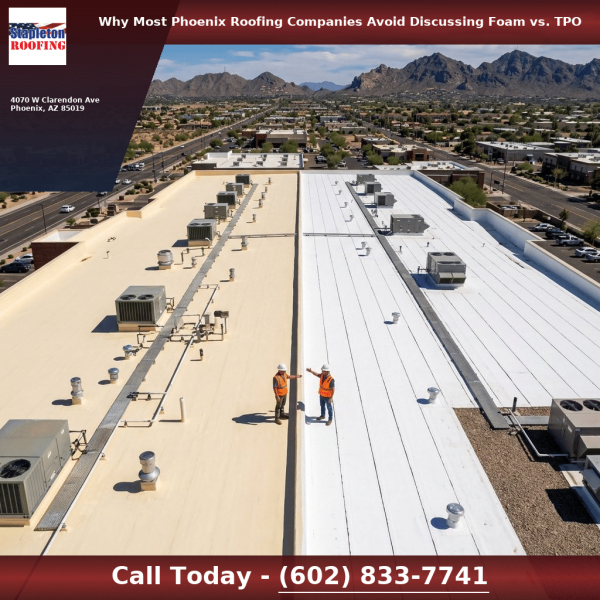
Should You Choose Foam or TPO Roofing in Phoenix?

Side-by-side comparison of spray foam roofing & TPO membrane roofing

Why Most Phoenix Roofing Companies Avoid Discussing Foam vs. TPO: The Truth About Material Selection

Key Takeaways:

  • Most Phoenix commercial roofing companies avoid detailed foam vs. TPO comparisons because they lack specialized expertise in both systems — and that avoidance tells you everything about their qualifications.
  • Foam and TPO roofing each demand distinct installation skills, equipment, and climate-specific knowledge that generalist contractors simply don’t possess.
  • Asking the right technical questions before hiring any Phoenix commercial roofing company is the fastest way to separate true specialists from general roofers chasing commercial contracts.

If you’ve called several Phoenix commercial roofing companies about a flat roof replacement, you may have noticed something odd. Most contractors either push one system without fully explaining the other, or they give vague answers when you ask specific questions about material performance. That pattern isn’t a coincidence. It’s an industry habit rooted in a simple truth: detailed material knowledge is hard to fake, and many contractors would rather steer conversations than reveal the limits of their expertise.

At Stapleton Roofing Company, ROC 269773, we believe commercial property owners deserve straight answers. With 40 years serving the Phoenix area, Pat Stapleton and the team have installed, inspected, and re-roofed enough commercial buildings to know exactly why this knowledge gap exists — and what you should do about it.

The Materials Most Contractors Don’t Want to Explain

Commercial flat roofing in Phoenix comes down to two dominant systems for most property owners: spray polyurethane foam (SPF) and thermoplastic polyolefin (TPO) membrane. Both are legitimate, high-performing options. However, they require fundamentally different installation approaches, equipment, and climate-specific expertise.

Here’s the industry dynamic that most Phoenix commercial roofing companies won’t admit: a contractor who primarily installs shingles and built-up roofing systems is not a specialist in either foam or TPO. Many commercial roofing contractors dabble in both systems without mastering either. When you ask them to compare the two materials honestly, they can’t — because their experience base doesn’t support a genuine comparison.

So what do they do instead? They default to the system they installed last month, or the one their supplier is currently promoting. They tell you TPO is “the industry standard” without explaining why it might not suit your building’s specific design. Alternatively, they claim foam is “superior” without disclosing that improper foam application creates moisture problems that compound over time.

The National Roofing Contractors Association recognizes both systems as viable commercial roofing solutions, but proper installation training differs significantly between them. Understanding why helps you identify which Phoenix commercial roofing companies actually know what they’re doing.

Foam Roofing: Why Installation Expertise Determines Everything

Spray polyurethane foam roofing is, arguably, the most technically demanding system used on commercial buildings in Arizona. When installed correctly by qualified Phoenix commercial roofing companies, it creates a seamless, monolithic surface with exceptional insulation properties and inherent waterproofing. When installed poorly, it becomes a liability that traps moisture and degrades rapidly in UV exposure.

What makes foam roofing so technical? Several interconnected factors:

Surface preparation is non-negotiable. The substrate must be completely dry, clean, and properly primed before foam application begins. Any moisture trapped beneath the foam layer will cause adhesion failure and blistering. In Phoenix’s climate, ambient humidity matters — but so does residual moisture from overnight condensation or recent rain.

Application conditions must fall within tight parameters. Temperature, humidity, and wind speed all affect how foam cells form during the spray process. An experienced installer monitors these variables in real time and adjusts equipment settings accordingly. According to the Spray Polyurethane Foam Alliance, temperature and humidity directly affect foam rise, density, and surface quality.

Multi-layer sequencing requires precision timing. Foam is applied in multiple passes to achieve the desired thickness profile and establish proper drainage slopes. Rushing between passes or applying a single layer too thickly creates an uneven cell structure that compromises long-term performance.

UV-protective coatings complete the system. Bare foam degrades rapidly under Arizona’s intense solar exposure. The protective coating layer must be applied within the manufacturer’s specified window after foam installation and must maintain consistent thickness across the entire surface.

This is why our foam roofing services emphasize technical depth that most generalist contractors cannot match. Foam isn’t difficult to spray. It’s difficult to spray correctly, consistently, and with the quality control that a Phoenix commercial building demands.

TPO Systems: The Technical Details That Separate Phoenix Commercial Roofing Companies from Specialists

TPO membrane roofing has grown significantly in market share over the past two decades, and for good reason. Modern TPO membranes offer strong resistance to UV degradation, chemical exposure, and puncture — all relevant concerns for Arizona commercial properties.

However, TPO installation has its own set of technical demands that many Phoenix commercial roofing companies underestimate, particularly in desert climates.

Membrane selection matters more than most contractors acknowledge. TPO is not a single product. Membrane thickness varies, and thicker membranes perform substantially better under Phoenix’s thermal cycling — the repeated expansion and contraction caused by extreme daytime heat followed by cooler nights. A contractor who doesn’t discuss membrane thickness in terms of your building’s specific thermal exposure is skipping a critical specification step.

Hot-air welding is the heart of TPO installation quality. All TPO seams are heat-welded using specialized equipment that must be calibrated for ambient temperature conditions. Too little heat produces an incomplete weld that opens under stress. Too much heat burns through the membrane. In Phoenix summers, ambient temperatures significantly affect the starting parameters. A skilled TPO installer adjusts weld temperatures and speeds throughout the day as conditions change.

Thermal expansion management requires thoughtful detailing at penetrations, edges, and transitions. TPO expands and contracts with temperature swings. Improperly detailed terminations pull away from walls and curbs over time, creating entry points for water intrusion. This is a common failure mode on Phoenix commercial buildings where inexperienced installers underestimated the scale of thermal movement.

Explore our TPO roofing services to understand how a specialist approach to membrane selection and welding quality translates into long-term performance on Arizona commercial properties.

The U.S. Department of Energy’s Building Technologies Office notes that reflective roofing membranes like TPO can meaningfully reduce cooling loads in hot climates — but only when installed with proper seam integrity and appropriate membrane weight.

Cost vs. Value: What the Numbers Don’t Tell You

Commercial property owners frequently request side-by-side cost comparisons between foam and TPO. The comparison is useful — but incomplete without understanding what drives cost differences and what each investment actually delivers.

Foam roofing typically carries a higher upfront installation cost than TPO membrane for the same square footage. However, foam’s seamless nature eliminates seam failures, which are the most common TPO repair expense over time. Additionally, foam’s insulation value — measured as R-value per inch — can reduce cooling costs in Phoenix’s brutal summers, offsetting operational expenses across the building’s life.

TPO systems generally offer lower initial costs and faster installation timelines for large flat-roof commercial buildings. High-quality membranes with proper welds and detailed terminations perform reliably for many years. The critical variables are membrane thickness, welder certification, and installer experience with Phoenix-specific thermal conditions.

Neither system universally “wins” on cost or value. The right answer depends on your building’s age, substrate condition, drainage design, mechanical equipment penetrations, and your organization’s maintenance capacity. Any Phoenix commercial roofing company that tells you one system is always better is either uninformed or trying to sell you on their comfort zone.

Learn more about commercial roofing evaluation and how to frame a meaningful cost comparison for your specific property.

How to Evaluate Contractor Claims About Material Performance — A Guide for Phoenix Commercial Property Owners

Knowing what questions to ask separates well-protected commercial properties from expensive mistakes. Here are practical evaluation criteria when comparing Phoenix commercial roofing companies:

Ask for system-specific experience documentation: How many foam roofing projects have they completed in the past three years? How many TPO installations? Can they show you comparable commercial properties they’ve serviced in the Phoenix area? Vague answers indicate limited experience.

Test their technical vocabulary: Ask about their foam application equipment — specifically, how they calibrate for Arizona’s humidity and temperature ranges. Ask which TPO manufacturers’ welding certification their crew holds. A knowledgeable contractor readily answers these questions. A generalist hesitates or deflects.

Request references from similar building types: A contractor with strong residential roofing references is not equivalent to one with documented commercial flat-roof experience. Commercial buildings have different load requirements, drainage considerations, and occupancy-related constraints.

Verify ROC licensing: Arizona’s Registrar of Contractors maintains public records for all licensed contractors. Stapleton Roofing holds ROC 269773. Confirm any contractor you’re evaluating holds a valid commercial license before proceeding.

Evaluate their inspection process: A specialist will conduct a thorough substrate assessment before recommending any system. If a contractor quotes a job without inspecting your roof, that’s a significant red flag.

Use our contact page to schedule a technical consultation with Stapleton Roofing. We welcome the hard questions — because we’ve been answering them for 40 years in the Phoenix market.

In 2026, the Phoenix commercial real estate market continues to grow, and building owners face increasingly complex decisions about roofing systems that affect energy costs, maintenance budgets, and long-term asset value. The difference between a specialist and a generalist isn’t always obvious in a sales conversation — but it becomes very clear in how a roof performs five years after installation. Choose Phoenix commercial roofing companies that prove their expertise through technical depth, not marketing language.

Frequently Asked Questions About Foam vs. TPO Roofing Truth

Why don't most roofing contractors offer detailed comparisons of foam vs. TPO?

Many contractors lack the specialized experience with both systems to provide accurate comparisons. As a result, they steer clients toward whichever system they’re more comfortable installing rather than recommending the best fit for the building. A contractor who can genuinely compare both systems in technical terms has likely installed both extensively — and that depth of experience is worth prioritizing.

Foam requires precise spray techniques, proper surface preparation, weather condition monitoring, and multi-layer application, which demand specialized equipment and extensive training. Ambient temperature, humidity, and wind speed all influence how the foam cells form during application. Miss any of these variables, and the resulting roof can trap moisture, develop uneven thickness, or degrade prematurely under Phoenix’s intense UV rays.

Ask about their welding certification, membrane selection criteria for Arizona heat, and specific techniques for handling thermal expansion in desert conditions. A knowledgeable TPO installer explains how they adjust weld parameters throughout the day as temperatures rise. They also discuss membrane thickness in the context of your building’s thermal cycling exposure — not just as a generic specification.

Both can excel when properly installed by specialists, but the choice depends on building design, usage patterns, and long-term maintenance preferences — factors that require expert evaluation. Foam offers seamless waterproofing and insulation advantages. TPO offers installation speed and strong UV resistance in thicker formulations. The right answer for your property requires an on-site assessment, not a general recommendation.

Look for system-specific experience, verifiable ROC licensing, willingness to discuss technical details, and a documented substrate inspection process. Bids that arrive without an on-roof assessment are guesses, not proposals. Additionally, compare specifications — membrane thickness, foam density, coating type, and warranty terms — not just total price. A lower bid that skips critical specifications rarely delivers equivalent long-term value.

Foam is particularly well-suited to buildings with irregular penetrations, complex rooflines, or existing substrates that would make membrane installation difficult. However, buildings with heavy foot traffic from rooftop mechanical maintenance may require protective walk pads and more frequent coating inspections. An experienced foam roofing specialist evaluates these factors during the initial assessment and recommends accordingly.

Arizona’s ROC licensing confirms that a contractor has met state requirements for commercial work, carries required insurance, and is subject to regulatory oversight if disputes arise. It’s a baseline qualification, not a guarantee of quality — but working with an unlicensed contractor eliminates legal recourse and often signals broader professionalism concerns. Always verify licensing at roc.az.gov before signing any commercial roofing contract.

Why Trust Stapleton Roofing Company

stapleton roofing crew

Stapleton Roofing Company is a family-owned and locally operated roofing contractor serving homeowners and businesses across Arizona. With more than 40 years of experience, we have earned a reputation as one of the most trusted and respected names in the roofing industry. Our team of licensed, bonded, and insured professionals provides comprehensive roofing services designed for Arizona’s demanding climate—from the intense desert sun to seasonal monsoon rains.

As leading Arizona roof contractors, our mission is simple: deliver honest service, unmatched workmanship, and roofs that stand the test of time. Every project we complete reflects our values—integrity, quality, and safety—and our dedication to customer satisfaction has made us the first choice for thousands of homeowners and businesses statewide.

Our Roofing Services Include:

  • Roof Repair: Leak detection, tile replacement, storm damage repair, and preventative maintenance.
  • Roof Replacement: Full tear-off and installation for shingle, tile, foam, and flat roofing systems.
  • Roof Inspections: Certified inspections for real estate, insurance, and property management.
  • Commercial Roofing: TPO, foam, and flat roofing systems designed for durability and energy efficiency.
  • Residential Roofing: Tile, shingle, and foam roof systems customized for Arizona homes.
  • Roof Coatings & Restoration: Energy-efficient roof coatings that extend the lifespan of your roof.

From our office in Phoenix, Stapleton Roofing Company proudly serves customers across the Greater Phoenix Metro area, including Scottsdale, Glendale, Mesa, Chandler, Surprise, Avondale, Goodyear, Paradise Valley, Cave Creek, Sun City West, and Tempe.

Our team uses only high-quality materials from trusted manufacturers, ensuring that every roofing system we install is built to last and backed by solid warranties. From minor residential repairs to large-scale commercial projects, we approach every job with precision, professionalism, and a no-leak guarantee for the warranty period in your contract.

As active members of the Arizona Roofing Contractors Association (ARCA) and accredited by the Better Business Bureau (BBB), Stapleton Roofing Company continues to set the standard for excellence in the Arizona roofing industry.

Why Homeowners & Businesses Trust Stapleton Roofing Company

  • Family-Owned and Operated
  • Licensed, Bonded, and Insured (ROC #269773)
  • Free Roof Inspections and Honest Estimates
  • Daily Site Cleanup and Safety Protocols
  • Decades of Proven Experience with Arizona Roofs

Business Locations:

Stapleton Roofing Company – Phoenix, AZ
Serving Central Phoenix, Scottsdale, Tempe, Chandler, and Mesa

Stapleton Roofing Company – West Valley Service Area
Serving Peoria, Glendale, Surprise, Avondale, Goodyear, and the West Valley

Facebook
Twitter
LinkedIn
Tumblr
Reddit

Get a Free Roofing Estimate from Stapleton

Ready to secure your home or business with expert roofing services? Contact Stapleton Roofing today for a free, no-obligation estimate on residential or commercial roofing, and ensure your property is protected by the best.

Leave a Reply

Your email address will not be published. Required fields are marked *