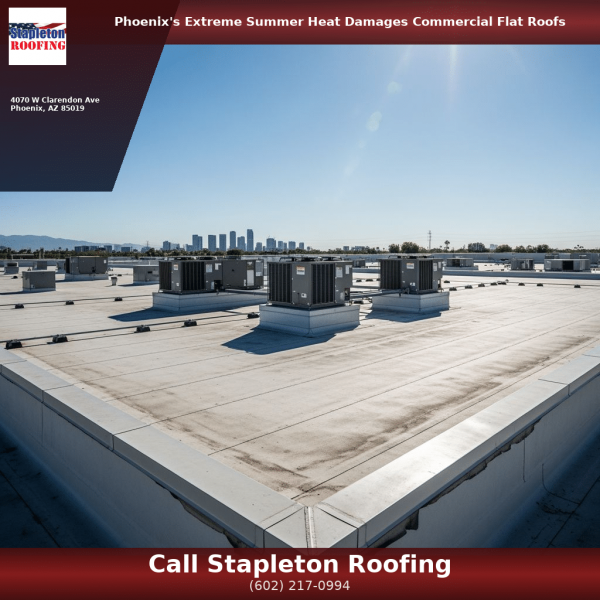
How Phoenix’s Extreme Summer Heat Damages Commercial Flat Roofs (And What to Do About It)
Key Takeaways:
- Phoenix roof surface temperatures can reach 160–180°F on dark membranes, accelerating membrane seam separation, flashing pull-out, and blister formation far beyond northern-climate design assumptions.
- Not all heat damage is equal — some signs demand immediate repair, others warrant scheduled attention within 30–60 days, and some indicate a system approaching end-of-life requiring replacement planning.
- Addressing heat-stressed seams and flashing before monsoon season is the highest-ROI maintenance decision a Phoenix commercial property owner can make in 2026.
Phoenix does not just get hot. It gets categorically, systemically hot in ways that most commercial roofing specifications were never designed to accommodate. Ambient temperatures exceeding 115°F are routine in June and July. Dark membrane surfaces — modified bitumen in particular — routinely reach 160 to 180°F under direct sun. At those temperatures, roofing materials are not simply warm; they operate at the outer boundary of their engineered tolerance every single day, for weeks at a time. For facility managers responsible for a commercial building with a flat roof, sustained thermal loading creates four specific failure modes worth understanding before the peak of the heat season.
How Phoenix Heat Systematically Breaks Down Flat Roof Systems
Membrane Seam Separation in TPO and PVC Systems
TPO and PVC membranes are heat-welded at their seams — a bond that, when properly executed, is actually stronger than the membrane field itself. The problem in Phoenix is not a single high-temperature event. It is the cumulative effect of daily thermal cycling. A membrane that heats to 170°F during the afternoon and cools to 85°F overnight expands and contracts by a measurable fraction of an inch across every linear foot of membrane. Multiply that cycle across 180 summer days and across thousands of square feet of roof surface, and the mechanical stress on seam welds accumulates. Welds that are marginally thin — a common outcome of field conditions where the heat gun temperature or travel speed was slightly off — begin to peel open at the seam edge. Once that peeling begins, the next rain event drives water directly into the seam channel.
HVAC Curb Flashing Pull-Out
Commercial flat roofs typically carry significant HVAC equipment: rooftop units, exhaust fans, makeup air units, and condensers. Each unit sits on a curb, and each curb requires flashing that seals the membrane termination against the vertical curb face. That flashing attachment — whether it is a compression bar, a termination bar, or a counter-flashing detail — is subjected to the same thermal expansion and contraction cycle as the membrane field. Over successive Phoenix summers, the flashing pulls away from the curb face, leaving a gap that ranges from a hairline to visibly open. This is among the most common sources of interior water damage in commercial buildings — and it is almost never visible from the ground. A facility manager whose HVAC curb flashing is pulling out will often attribute the leak to a roof-drain overflow before anyone thinks to inspect the curb detail itself.
Ponding Risk After HVAC Installations
Flat roofs are never truly flat. They are designed with a positive drainage pitch — typically a minimum of one-quarter inch per foot — that moves rainwater toward internal drains or scuppers. HVAC installations conducted after original construction frequently compromise that pitch. A new curb, a new equipment pad, or even the re-routing of a condensate line can subtly redirect drainage flow, create low spots adjacent to equipment bases, and establish areas of ponding where water collects after rain. Ponding water adds structural load — one inch of standing water across a 10,000-square-foot roof adds approximately 52,000 pounds — and it accelerates membrane degradation at precisely the spots where ponding is occurring. In Phoenix, the monsoon season that follows the summer heat period delivers intense, short-duration rainfall that quickly reveals whether HVAC installations have altered the roof’s drainage geometry.
Modified Bitumen Blister Formation
Modified bitumen systems — torch-applied or cold-applied — rely on a continuous adhesive bond between membrane plies and, where applicable, between the membrane and the substrate. When moisture is present within or beneath the membrane assembly, sustained surface temperatures in the 160–180°F range convert that moisture to vapor. The vapor pressure has nowhere to go and forms blisters — raised, dome-shaped areas that range from a few inches to several feet in diameter. Small blisters are primarily a cosmetic concern. Large blisters, or blisters that rupture, expose the underlying membrane plies to UV degradation and eventually to water infiltration. In Phoenix, blisters that form in June and expand through July often rupture under monsoon foot traffic or debris impact in August.
Triage: Immediate Repair, Scheduled Repair, or Replacement Planning?
Not every heat-related finding is an emergency, and not every repair can reasonably wait 60 days. Knowing the difference helps facility managers allocate budget and vendor time appropriately.
Signs that require immediate attention — typically within one to two weeks — include:
- Open seam welds with visible separation of more than a quarter inch
- Flashing pull-out that has created a visible gap at a curb or wall termination
- Ruptured blisters exposing underlying plies to standing water
- Active interior water staining or ceiling damage that traces to a roof penetration
Damage that justifies a scheduled repair within 30 to 60 days includes:
- Seam edges showing early peel or probe-separation of less than a quarter inch
- Flashing that is beginning to lift but has not yet opened
- Blisters that are intact, non-rupturing, and not adjacent to drains or seams
- Minor ponding areas that dry within 48 hours of a rain event
End-of-life indicators that warrant replacement planning rather than repair include:
- Widespread seam delamination across multiple roof sections
- Membrane that is brittle, chalking heavily, or showing alligator-cracking across the field
- Multiple blister fields across a modified bitumen system with a documented age of 20-plus years
- A pattern of recurring flashing failures at the same locations despite repeated repairs
The distinction matters financially. Addressing a targeted seam repair now costs a fraction of the emergency mitigation — emergency call-out, interior drying, ceiling replacement — that follows a catastrophic failure during the monsoon. Replacement planning that begins in August, after the heat season, allows for budget cycles, specification development, and contractor scheduling in the cooler months, when installation quality is higher and contractor availability is better.
What a Summer Commercial Roof Inspection Covers — and the ROI Case for Doing It Now
A summer maintenance inspection for a commercial flat roof is not a general walkover. For Phoenix conditions specifically, a thorough inspection focuses on seam integrity at field and perimeter welds, flashing condition at every HVAC curb and wall termination, drain and scupper clearance, drainage geometry verification, and membrane surface condition, including blister mapping and UV degradation assessment. Infrared scanning conducted in the early morning, before the membrane reaches operating temperature, can detect subsurface moisture that is invisible to the naked eye.
The return-on-investment case is direct. Heat-stressed roofing systems that survive the summer often fail during the first significant monsoon event — because the seams that held under static thermal loading cannot handle the simultaneous hydraulic pressure of heavy, fast rainfall. The cost of an inspection and targeted repair program is consistently lower than the combined cost of emergency leak response, interior damage remediation, and business interruption. For a Phoenix commercial property heading into the 2026 monsoon season, the window between now and the first significant storm is the highest-value maintenance interval of the year.
Stapleton Roofing’s Commercial Inspection and Repair Services
Stapleton Roofing Company provides commercial roof inspections, targeted heat-damage repairs, and full system assessments for Phoenix-area commercial properties. Whether your building carries a TPO single-ply system, a PVC membrane, a modified bitumen assembly, or a spray polyurethane foam system, the company’s commercial division works with facility managers and property owners to identify heat-related damage, prioritize repairs by urgency, and develop a documented maintenance plan that protects the building through monsoon season and beyond. Contact Stapleton Roofing to schedule a commercial roof inspection before Phoenix’s peak heat window closes.
Frequently Asked Questions About Commercial Flat Roofs Heat Damage
How hot does a commercial flat roof surface actually get in Phoenix, Arizona?
Dark membrane surfaces — particularly aged modified bitumen — can reach 160-180°F during peak summer hours in Phoenix. Light-colored TPO or PVC membranes with reflective white surfaces typically run 20 to 40 degrees cooler, yet still reach surface temperatures well above 120°F during July and August. Those sustained temperatures are the primary driver of accelerated seam stress and flashing fatigue in the Phoenix commercial roofing market.
What is the most common heat-related failure on a commercial flat roof in Phoenix?
HVAC curb flashing pull-out is among the most common and most underdiagnosed failure modes. Facility managers often attribute interior water damage to drain overflow or membrane puncture before anyone inspects the curb termination detail. Membrane seam separation is the second most frequent finding, particularly at perimeter edge conditions and at laps that were originally under-welded.
Can a TPO roof in Phoenix be repaired, or does the heat damage require full replacement?
Most heat-related TPO damage — seam peeling, flashing lift, minor ponding distress — is repairable if caught before water has infiltrated the assembly. A qualified commercial roofing contractor can re-weld open seams, re-set flashing terminations, and address drainage issues without replacing the full membrane. Full replacement is the appropriate recommendation when seam delamination is widespread, when the membrane has become brittle due to UV degradation, or when the system is approaching or beyond its design life.
Why does monsoon rain specifically cause failures after a hot summer?
Heat-stressed seams and flashing gaps may remain temporarily stable under static conditions, but monsoon rain introduces hydraulic pressure — water driven horizontally by wind, water pooling faster than drains can evacuate it, and sudden temperature differentials as cool rain hits a 170°F membrane. Those conditions simultaneously stress the seam mechanically and thermally. A seam that held through July’s dry heat often cannot hold through August’s first significant storm.
How do I know if my commercial roof needs immediate repair versus a scheduled inspection?
Active interior water staining, visible open seams, or flashing gaps visible from the roof are all indicators of immediate-repair urgency. If the roof shows no active leaks but has visible early signs of seam lifting, intact blisters, or minor ponding, a scheduled inspection within 30 to 60 days is appropriate. A professional commercial roof inspection with documented findings is the most reliable way to triage heat damage accurately and allocate repair budget by priority.
Does roof color matter for heat damage in Phoenix commercial buildings?
Yes, significantly. Membrane color and reflectivity directly affect surface temperature, which in turn drives the rate of thermal expansion cycling, UV degradation, and blister formation. A white or light gray TPO membrane with a high solar reflectance index can reduce surface temperature by 20 to 40°F compared to a dark modified bitumen surface. That temperature reduction measurably extends membrane service life. However, even reflective membranes experience thermal cycling stress at Phoenix-like ambient temperatures, so reflectivity reduces the risk of damage — it does not eliminate it.
Why Trust Stapleton Roofing Company
Stapleton Roofing Company is a family-owned and locally operated roofing contractor serving homeowners and businesses across Arizona. With more than 40 years of experience, we have earned a reputation as one of the most trusted and respected names in the roofing industry. Our team of licensed, bonded, and insured professionals provides comprehensive roofing services designed for Arizona’s demanding climate—from the intense desert sun to seasonal monsoon rains.
As leading Arizona roof contractors, our mission is simple: deliver honest service, unmatched workmanship, and roofs that stand the test of time. Every project we complete reflects our values—integrity, quality, and safety—and our dedication to customer satisfaction has made us the first choice for thousands of homeowners and businesses statewide.
Our Roofing Services Include:
- Roof Repair: Leak detection, tile replacement, storm damage repair, and preventative maintenance.
- Roof Replacement: Full tear-off and installation for shingle, tile, foam, and flat roofing systems.
- Roof Inspections: Certified inspections for real estate, insurance, and property management.
- Commercial Roofing: TPO, foam, and flat roofing systems designed for durability and energy efficiency.
- Residential Roofing: Tile, shingle, and foam roof systems customized for Arizona homes.
- Roof Coatings & Restoration: Energy-efficient roof coatings that extend the lifespan of your roof.
From our office in Phoenix, Stapleton Roofing Company proudly serves customers across the Greater Phoenix Metro area, including Scottsdale, Glendale, Mesa, Chandler, Surprise, Avondale, Goodyear, Paradise Valley, Cave Creek, Sun City West, and Tempe.
Our team uses only high-quality materials from trusted manufacturers, ensuring that every roofing system we install is built to last and backed by solid warranties. From minor residential repairs to large-scale commercial projects, we approach every job with precision, professionalism, and a no-leak guarantee for the warranty period in your contract.
As active members of the Arizona Roofing Contractors Association (ARCA) and accredited by the Better Business Bureau (BBB), Stapleton Roofing Company continues to set the standard for excellence in the Arizona roofing industry.
Why Homeowners & Businesses Trust Stapleton Roofing Company
- Family-Owned and Operated
- Licensed, Bonded, and Insured (ROC #269773)
- Free Roof Inspections and Honest Estimates
- Daily Site Cleanup and Safety Protocols
- Decades of Proven Experience with Arizona Roofs
Business Locations:
Stapleton Roofing Company – Phoenix, AZ
Serving Central Phoenix, Scottsdale, Tempe, Chandler, and Mesa
Stapleton Roofing Company – West Valley Service Area
Serving Peoria, Glendale, Surprise, Avondale, Goodyear, and the West Valley