How to Find a Reliable Roofing Contractor in Phoenix, AZ (Without Getting Burned)
Key Takeaways:
- Verify any Phoenix roofing contractor’s ROC license at roc.az.gov before signing anything — the license classification, status, and complaint history are all publicly searchable in minutes.
- ost-monsoon storm chasers are one of the biggest threats to Phoenix homeowners; specific warning signs (out-of-state plates, upfront payment demands, no local office) can save you thousands.
- A legitimate local contractor like Stapleton Roofing Company will hand you verifiable credentials — ROC 269773, BBB accreditation, ARCA membership — and welcome every question you ask.
The call comes three days after a monsoon. A polite stranger at your door says he noticed your roof took some hits, offers to take a look for free, and promises he can work with your insurance. He seems friendly. He has a business card. He is gone with your deposit two weeks later, and your roof is still leaking.
This scenario is not a worst-case hypothetical — it plays out across the Valley every monsoon season. If you are a Phoenix homeowner or property manager comparing bids right now, or if a previous contractor left you holding a bill and a bucket, this guide is built for you. The steps below will help you quickly and confidently sort legitimate local roofers from opportunists.
Step One: Verify the ROC License Before Anything Else
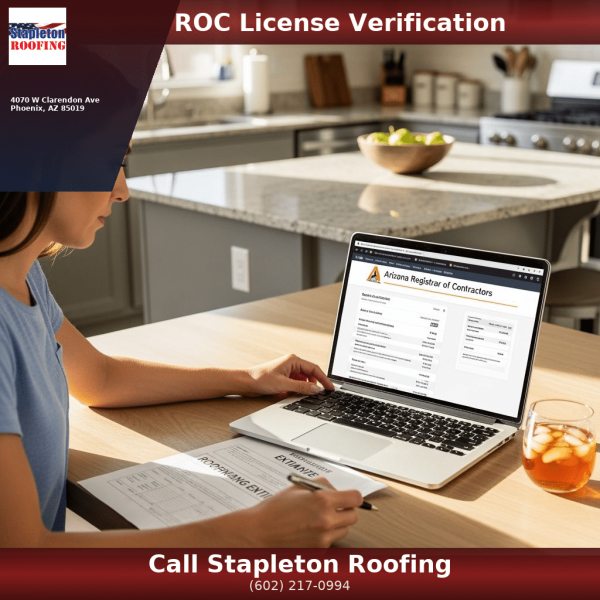
Arizona’s Registrar of Contractors (ROC) maintains a public database of every licensed contractor in the state. Checking takes about 90 seconds and is the single most important step you can take.
Here is exactly how to do it:
1. Go to roc.az.gov and click “License Search.”
2. Search by the contractor’s name, business name, or license number.
3. Review the license classification — for residential roofing, look for an A-17 (residential roofing) endorsement under a Class B-1 or standalone A-17 license. Commercial work falls under a Class A General Engineering or B-1 Commercial license with the appropriate trade classification.
4. Confirm the license status reads “Active.”
5. Check the complaint and disciplinary history. Even one unresolved complaint is worth a follow-up conversation.
If a contractor cannot give you their ROC number before you ask, or if the number does not match an active license in the database, walk away. No legitimate Phoenix roofer will be offended by this check — they expect it.
Storm Chasers: The Phoenix-Specific Threat You Need to Recognize
Phoenix monsoon season runs roughly June through September. In the weeks that follow a major storm, the Valley fills with what the industry calls “storm chasers” — out-of-state roofing crews who follow damage events, collect deposits, and disappear before the work is finished or warranted.
The warning signs are specific enough that you should be able to spot them from your front door:
- Out-of-state license plates on their vehicles or trailers
- Door-to-door solicitation immediately after a storm
- Pressure to sign a contract the same day, often framed as a “limited-time insurance window”
- A request for full payment — or a large portion of it — upfront before work begins
- No verifiable local office address (a P.O. box is not an office)
- No ROC license number on their vehicle signage, business card, or estimate paperwork
Arizona law requires ROC license numbers to appear on all contractor advertising. If the truck does not have one, that alone is a red flag. Additionally, out-of-state contractors performing work in Arizona must be licensed here — their home-state license does not transfer. Checking roc.az.gov immediately tells you whether the crew at your door has any legal standing to work on your property.
What a Legitimate Estimate Looks Like — and What Raises Flags
A trustworthy roofing estimate is a document, not a number scrawled on a business card. Here is what it should contain:
- A line-item breakdown of materials, labor, disposal, and any required permits
- The specific material manufacturer and product name (not just “tile” or “shingle”)
- A clear project timeline with start and completion dates
- The contractor’s ROC license number, physical address, and insurance information
- Warranty terms spelled out — both the manufacturer’s material warranty and the contractor’s workmanship warranty, separately
Red-flag estimates tend to do the opposite. They are vague on materials, heavy on urgency language (“if we start this week, we can lock in this price”), and silent on warranty terms. If a contractor resists putting specifics in writing, that resistance is your answer.
Why Phoenix-Specific Experience Is Not Optional
Roofing in Phoenix is a specialized discipline. The desert environment creates conditions that contractors from other climates simply have not encountered.
Consider what your roof actually faces here. Summer surface temperatures on low-slope commercial roofing can exceed 170°F, which accelerates material degradation in products not rated for extreme heat. Flat or low-slope roofs — common on both mid-century Phoenix homes and commercial properties — require drainage solutions designed for the sudden, intense rainfall that monsoons deliver, not the steady rainfall patterns of wetter climates. Tile roofing, which dominates the residential market in the Valley, demands specific installation knowledge: improper flashing, inadequate underlayment, or tile cut incorrectly around penetrations can hold moisture against the deck for months before you see a stain on your ceiling.
A contractor who learned their trade in Ohio or Georgia has likely never worked through a Phoenix monsoon cycle. That experience gap shows up in installation decisions that look fine in June and leak by August.
Specifically, ask any contractor you are evaluating these questions:
- How many tile roofs have they installed or repaired in the Phoenix metro area?
- What underlayment products do they use in high-heat applications, and why?
- How do they handle low-slope drainage on flat-roof commercial properties?
- Can they provide local references from jobs completed in the past 12 to 24 months?
The answers — and the confidence with which they are given — will tell you more than any marketing material.
How Stapleton Roofing’s Credentials Apply to This Checklist
Every verification step above is one that Stapleton Roofing Company can satisfy directly. This section is not a sales pitch; it is a checklist applied to a specific company so you can see what the verification process looks like in practice.
ROC License: Stapleton Roofing holds ROC license number 269773. You can verify the status, classification, and complaint history yourself at roc.az.gov right now — that is the point.
Insurance: Request a certificate of insurance before any work begins. A legitimate contractor carries both general liability and workers’ compensation coverage. Workers’ comp matters especially in roofing — if a crew member is injured on your property and the contractor carries no coverage, you may face exposure.
Industry Membership: Stapleton Roofing is a member of the Arizona Roofing Contractors Association (ARCA), the state’s primary professional trade organization. ARCA membership requires adherence to industry standards and connects members to ongoing technical education — both of which are particularly relevant to the material and code updates that affect Phoenix roofing in 2026.
BBB Accreditation: The company holds Better Business Bureau accreditation, which requires meeting standards for transparency, responsiveness to complaints, and honest advertising. The BBB record is publicly searchable.
Local Presence: With offices in both Phoenix and Peoria, Stapleton Roofing has a fixed, verifiable address — not a P.O. box, not a temporary job trailer. Local accountability means that when a workmanship issue arises six months after installation, there is someone to call who is still here.
Guarantee: The company backs its roof installations with a no-leak guarantee for the warranty period in the contract (never less than 2 years), and the manufacturer warranties the materials. Ask for the specific terms in writing before you sign — exactly as you should ask any contractor.
Frequently Asked Questions About Reliable Roofing Contractor in Phoenix
How do I verify a roofing contractor's ROC license in Arizona?
Go to roc.az.gov, select “License Search,” and enter the contractor’s business name or license number. Confirm the license is active, check the correct trade classification for the work being performed, and review any complaint or disciplinary history before proceeding.
What insurance should a Phoenix roofing contractor carry?
At a minimum, a legitimate contractor should carry general liability insurance and workers’ compensation coverage. Request a certificate of insurance — not just a verbal confirmation — and verify that the policy dates cover your project period. Workers’ comp is critical in roofing because the job poses a real risk of injury.
How can I recognize a storm chaser in Phoenix?
Key signs include out-of-state license plates, door-to-door solicitation immediately after a monsoon, no ROC license number visible on their vehicle or estimate, demands for a large upfront payment, and the absence of a verifiable local office address. Any one of these signals warrants extra scrutiny; more than one warrants a decline.
What should a roofing estimate in Phoenix include?
A complete estimate should list materials by manufacturer and product name, labor costs separately, disposal fees, permit costs, a project timeline, and full warranty terms — both for materials and workmanship. Vague estimates that omit these details put you at risk once the project is underway.
Does a roofing contractor's local Phoenix experience really matter?
Yes, meaningfully so. Phoenix-specific conditions — extreme heat, monsoon drainage demands, and the prevalence of tile roofing — require installation decisions and material choices that differ from those in other climates. A contractor without sustained local experience may make choices that appear correct but fail under the specific stresses your roof faces here.
What is ARCA and why does it matter when choosing a roofer?
ARCA stands for the Arizona Roofing Contractors Association. It is the state’s primary professional trade organization for roofing contractors. Membership requires adherence to industry standards and involves access to ongoing education specific to Arizona roofing conditions, materials, and code changes — all of which directly affect the quality of work performed on your property.
Sources
- ROC license classification and search tool — Arizona Registrar of Contractors: https://roc.az.gov
- Arizona Roofing Contractors Association membership and standards — ARCA: https://www.arcaonline.org
- BBB accreditation standards — Better Business Bureau: https://www.bbb.org/bbb-accreditation-standards
Why Trust Stapleton Roofing Company
Stapleton Roofing Company is a family-owned and locally operated roofing contractor serving homeowners and businesses across Arizona. With more than 40 years of experience, we have earned a reputation as one of the most trusted and respected names in the roofing industry. Our team of licensed, bonded, and insured professionals provides comprehensive roofing services designed for Arizona’s demanding climate—from the intense desert sun to seasonal monsoon rains.
As leading Arizona roof contractors, our mission is simple: deliver honest service, unmatched workmanship, and roofs that stand the test of time. Every project we complete reflects our values—integrity, quality, and safety—and our dedication to customer satisfaction has made us the first choice for thousands of homeowners and businesses statewide.
Our Roofing Services Include:
- Roof Repair: Leak detection, tile replacement, storm damage repair, and preventative maintenance.
- Roof Replacement: Full tear-off and installation for shingle, tile, foam, and flat roofing systems.
- Roof Inspections: Certified inspections for real estate, insurance, and property management.
- Commercial Roofing: TPO, foam, and flat roofing systems designed for durability and energy efficiency.
- Residential Roofing: Tile, shingle, and foam roof systems customized for Arizona homes.
- Roof Coatings & Restoration: Energy-efficient roof coatings that extend the lifespan of your roof.
From our office in Phoenix, Stapleton Roofing Company proudly serves customers across the Greater Phoenix Metro area, including Scottsdale, Glendale, Mesa, Chandler, Surprise, Avondale, Goodyear, Paradise Valley, Cave Creek, Sun City West, and Tempe.
Our team uses only high-quality materials from trusted manufacturers, ensuring that every roofing system we install is built to last and backed by solid warranties. From minor residential repairs to large-scale commercial projects, we approach every job with precision, professionalism, and a no-leak guarantee for the warranty period in your contract.
As active members of the Arizona Roofing Contractors Association (ARCA) and accredited by the Better Business Bureau (BBB), Stapleton Roofing Company continues to set the standard for excellence in the Arizona roofing industry.
Why Homeowners & Businesses Trust Stapleton Roofing Company
- Family-Owned and Operated
- Licensed, Bonded, and Insured (ROC #269773)
- Free Roof Inspections and Honest Estimates
- Daily Site Cleanup and Safety Protocols
- Decades of Proven Experience with Arizona Roofs
Business Locations:
Stapleton Roofing Company – Phoenix, AZ
Serving Central Phoenix, Scottsdale, Tempe, Chandler, and Mesa
Stapleton Roofing Company – West Valley Service Area
Serving Peoria, Glendale, Surprise, Avondale, Goodyear, and the West Valley