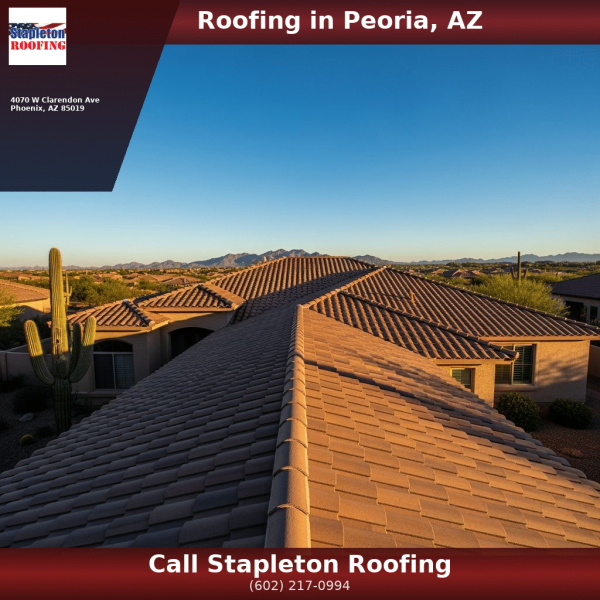
Roofing in Peoria, AZ: What Homeowners Need to Know Before Repair or Replacement
Key Takeaways:
- Peoria’s tile-heavy housing stock in communities like Vistancia and Westwing Pointe requires roofing contractors who understand HOA requirements and tile-specific repair methods.
- Homes built in the 1990s through the 2010s are approaching or past their system life expectancy — a professional inspection in 2026 can determine whether repair or full replacement is the smarter investment.
- Stapleton Roofing Company serves Peoria, AZ homeowners with a licensed local presence (ROC #269773) and free estimates — so you know exactly what you’re dealing with before committing to anything.
Your roof took a hit last monsoon season. Or maybe you’ve noticed a few cracked tiles along the ridge of your Vistancia home, and you’re not sure whether a quick repair will hold — or whether you’re throwing money at a system that’s quietly failing underneath. Either way, the decision in front of you is one of the most consequential you’ll make as a homeowner, and the wrong call in either direction costs thousands.
This guide is written specifically for Peoria residents. Not the broader Phoenix metro. Not Scottsdale or Chandler. Peoria — the master-planned communities off Loop 303, the aging subdivisions near 75th and Olive, and the newer builds pushing north toward Lake Pleasant. The roofing realities here are distinct, and you deserve information that reflects where you actually live.
What Makes Peoria Roofing Different From the Rest of the Valley
Peoria’s housing stock has a recognizable profile. A large share of the area’s single-family homes was built between the mid-1990s and the early 2010s, concentrated in developments such as Westwing Pointe, Terramar, Trilogy at Vistancia, and Vistancia Village. The dominant roofing material across these communities is concrete or clay tile — originally installed to satisfy both HOA aesthetic standards and the area’s brutal summer heat load.
That tile was built to last. However, “built to last” doesn’t mean maintenance-free. The National Roofing Contractors Association notes that concrete tile systems typically have a 25- to 50-year lifespan under ideal conditions — but the underlayment beneath that tile, the component that does the real waterproofing work, often reaches the end of its life well before the tile itself shows obvious wear. A home built in 1998 with original underlayment may look perfectly fine from the curb while quietly developing leak pathways that only reveal themselves after a heavy monsoon.
Peoria’s northwest Valley location also shapes how storm damage accumulates, which differs from that in central Phoenix. Dust storm wind vectors generated along the Hassayampa River corridor can approach Peoria neighborhoods from the southwest, lifting at angles that drive debris and moisture under ridge caps and hip tiles — areas that stay dry during a standard Phoenix haboob but take repeated hits in this part of the Valley. If you’ve lived in Peoria for more than a few years, you’ve watched those storms roll in off the open desert. Your roof has too.
Additionally, the master-planned communities in Peoria maintain active HOA architectural review processes. Any visible roofing work — replacement color, profile changes, even certain repair materials — may require prior approval. Working with a contractor unfamiliar with those processes can create compliance headaches that delay your project and cost extra money to resolve.
Repair or Replace? What the Decision Actually Looks Like for Peoria Homeowners
This is where most homeowners get stuck, and where a second opinion from an independent contractor matters most. The honest framework involves three variables: age, condition, and remaining system life.
Age thresholds to keep in mind:
- Underlayment installed before 2000 is almost certainly past its rated service life and should be considered for replacement, regardless of how the tile looks.
- Systems installed between 2000 and 2010 are in a diagnostic gray zone — a professional inspection can identify whether spot repairs extend useful life meaningfully or simply delay an inevitable replacement.
- Systems installed after 2010 with no storm damage history are typically strong repair candidates, especially if the tile itself is intact and the flashing details are sound.
Condition tells a more immediate story. Cracked or slipped tiles, granule accumulation in gutters, soft spots visible from the attic, or active staining on interior ceilings are signals that your system is communicating something real. A single cracked tile on a 2015 roof is a repair. Widespread underlayment exposure on a 1997 roof is a replacement conversation — and delaying it usually means the eventual replacement costs more because water intrusion has reached the decking.
The financial comparison matters too. A targeted repair on a sound system typically runs a fraction of a full replacement. But a series of repeated repairs on an aging system adds up fast, and each monsoon season introduces new risk. A straightforward inspection — not a high-pressure sales call — gives you actual data to make the call confidently.
Why the Contractor’s Location Inside Peoria Actually Matters
Peoria homeowners sometimes call a contractor based in Tempe or Mesa who claims to serve the entire Valley. That contractor may do good work. But when your repair appointment conflicts with a full-day job in Chandler, or when a follow-up inspection requires a second 40-mile round trip, you’re competing with every other client spread across the metro. Response time degrades. Scheduling windows stretch. And when the next monsoon hits, getting someone back to your property quickly becomes genuinely difficult.
A contractor operating locally in Peoria eliminates that friction. Faster initial response, faster follow-up after storms, and — critically — a team that recognizes the specific HOA architectural standards for Vistancia or Trilogy without needing to look them up each time. Familiarity with local permit offices, local material suppliers, and the specific tile profiles common to Peoria’s master-planned communities isn’t glamorous, but it translates directly into smoother projects and fewer surprises.
Peoria’s building department processes roofing permits, and working with a contractor who regularly pulls permits in the city — rather than treating it as unfamiliar bureaucratic territory — makes a measurable difference in project timelines. Some repairs don’t require a permit; full replacements almost always do. Knowing the process in advance rather than figuring it out on your project is exactly the kind of local knowledge that protects your timeline and budget.
Stapleton Roofing Company: Serving Peoria, AZ Homeowners
Stapleton Roofing Company works specifically with Peoria homeowners across the communities and neighborhoods described throughout this guide. The company holds an Arizona Registrar of Contractors license ROC #269773 — you can verify that license directly through the Arizona ROC’s public license lookup before making any decision.
If you’re comparing quotes, evaluating damage after a recent storm, or simply trying to figure out your roof’s actual condition heading into 2026’s monsoon season, a free estimate provides a professional baseline with no obligation. You’ll get a clear picture of what’s happening with your system, your realistic options, and what a repair or replacement would actually involve in your specific home.
Stapleton Roofing offers free estimates for Peoria homeowners. Reach out directly to schedule an inspection at your convenience — before the next storm makes the decision for you.
Frequently Asked Questions About Roof Repair or Replacement Decision in Peoria
How do I know if my Peoria home needs a full roof replacement or just a repair?
Age and condition together tell the clearest story. If your roof was installed before 2000, the underlayment is likely past its service life regardless of how the tile looks. If your system is newer but you’re seeing widespread cracked tiles, interior staining, or soft spots in the decking, a professional inspection will clarify whether repair addresses the real problem or only the visible symptom. A trustworthy contractor gives you both options with honest trade-offs — not a predetermined answer.
Does my HOA in Vistancia or Westwing Pointe need to approve roofing work?
Most master-planned communities in Peoria require HOA architectural review for any work that changes the visible roofline or material profile. Full replacements almost always require approval; certain repairs may not, depending on the community’s CC&Rs. Your contractor should be familiar with this process and help you submit any required documentation before work begins, not after.
What roofing materials are most common in Peoria, AZ?
Concrete and clay tile dominate Peoria’s newer master-planned communities, both for aesthetic reasons and for their thermal performance in extreme heat. Older sections of Peoria may have two- or three-tab asphalt shingle systems, particularly in subdivisions built before the mid-1990s. Each material has different maintenance schedules, repair methods, and replacement considerations.
How does monsoon season affect Peoria roofs specifically?
Peoria’s northwest Valley location means dust-storm wind patterns can arrive from the southwest along the Hassayampa River corridor, creating uplift angles that differ from those of storms hitting central Phoenix directly. Ridge caps, hip tiles, and flashing details take the brunt of this exposure. After significant monsoon events, a visual inspection — even just from the ground with binoculars — can catch displaced tiles before they become active leak points.
Is Stapleton Roofing licensed to work in Peoria, AZ?
Yes. Stapleton Roofing Company holds an Arizona Registrar of Contractors license, ROC #269773, which authorizes roofing work across Arizona, including Peoria. You can verify this license independently through the Arizona ROC’s public database at roc.az.gov before scheduling any work.
How long does a roofing project typically take in Peoria?
Timeline depends on scope. A targeted tile repair on a straightforward section of roof can often be completed in a single visit. A full replacement for a larger Peoria home — particularly one requiring a city permit — typically takes several days of active work, with permit processing adding time beforehand. Your contractor should give you a realistic project timeline in writing before work begins.
What should I look for when comparing roofing contractors in Peoria?
Verify the Arizona ROC license independently, not just from the contractor’s website. Ask specifically about their experience with tile systems and HOA communities in Peoria. Confirm that they pull permits when required. Get a written scope of work before any contract is signed. And pay attention to communication — a contractor who is hard to reach before the job rarely gets easier to reach once the work starts.
Sources
- Tile roofing lifespan and underlayment service life — National Roofing Contractors Association (NRCA): https://www.nrca.net
- Arizona Registrar of Contractors public license verification — Arizona ROC: https://roc.az.gov
Why Trust Stapleton Roofing Company
Stapleton Roofing Company is a family-owned and locally operated roofing contractor serving homeowners and businesses across Arizona. With more than 40 years of experience, we have earned a reputation as one of the most trusted and respected names in the roofing industry. Our team of licensed, bonded, and insured professionals provides comprehensive roofing services designed for Arizona’s demanding climate—from the intense desert sun to seasonal monsoon rains.
As leading Arizona roof contractors, our mission is simple: deliver honest service, unmatched workmanship, and roofs that stand the test of time. Every project we complete reflects our values—integrity, quality, and safety—and our dedication to customer satisfaction has made us the first choice for thousands of homeowners and businesses statewide.
Our Roofing Services Include:
- Roof Repair: Leak detection, tile replacement, storm damage repair, and preventative maintenance.
- Roof Replacement: Full tear-off and installation for shingle, tile, foam, and flat roofing systems.
- Roof Inspections: Certified inspections for real estate, insurance, and property management.
- Commercial Roofing: TPO, foam, and flat roofing systems designed for durability and energy efficiency.
- Residential Roofing: Tile, shingle, and foam roof systems customized for Arizona homes.
- Roof Coatings & Restoration: Energy-efficient roof coatings that extend the lifespan of your roof.
From our office in Phoenix, Stapleton Roofing Company proudly serves customers across the Greater Phoenix Metro area, including Scottsdale, Glendale, Mesa, Chandler, Surprise, Avondale, Goodyear, Paradise Valley, Cave Creek, Sun City West, and Tempe.
Our team uses only high-quality materials from trusted manufacturers, ensuring that every roofing system we install is built to last and backed by solid warranties. From minor residential repairs to large-scale commercial projects, we approach every job with precision, professionalism, and a no-leak guarantee for the warranty period in your contract.
As active members of the Arizona Roofing Contractors Association (ARCA) and accredited by the Better Business Bureau (BBB), Stapleton Roofing Company continues to set the standard for excellence in the Arizona roofing industry.
Why Homeowners & Businesses Trust Stapleton Roofing Company
- Family-Owned and Operated
- Licensed, Bonded, and Insured (ROC #269773)
- Free Roof Inspections and Honest Estimates
- Daily Site Cleanup and Safety Protocols
- Decades of Proven Experience with Arizona Roofs
Business Locations:
Stapleton Roofing Company – Phoenix, AZ
Serving Central Phoenix, Scottsdale, Tempe, Chandler, and Mesa
Stapleton Roofing Company – West Valley Service Area
Serving Peoria, Glendale, Surprise, Avondale, Goodyear, and the West Valley