How Phoenix’s Monsoon Season Damages Residential Tile Roofs

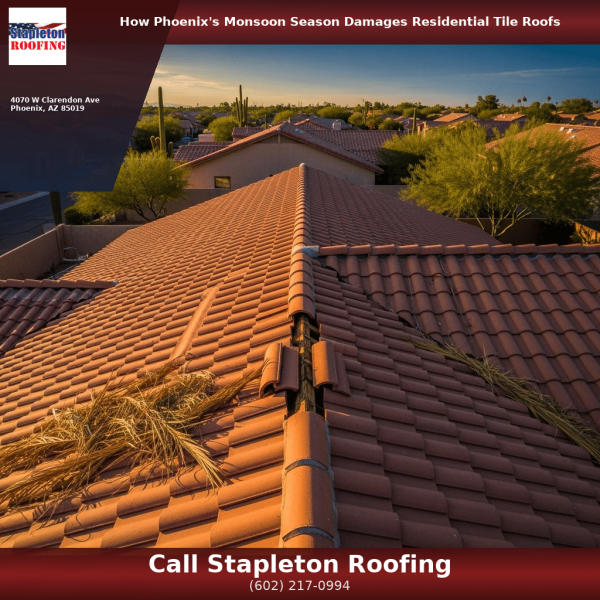
Clay tile roof in Phoenix Arizona damaged after monsoon storm

Key Takeaways:

  • Monsoon season creates tile-specific failure modes — cracked field tiles, displaced ridge caps, mortar erosion, and flashing separation — that quietly allow water to reach your underlayment long before a leak appears inside your home.
  • Underlayment degradation beneath an otherwise intact tile field is one of the most common hidden failure patterns in aging Phoenix tile roofs, and it is almost impossible to detect without a professional inspection.
  • Schedule a professional post-storm inspection after every significant monsoon event — catching a $300 repair early prevents a $10,000–$30,000 underlayment or decking replacement later.

Every July, the Valley transforms. Skies that baked at 115°F for months turn green at the horizon, winds spike to 60 mph in minutes, and rain arrives sideways. Your clay or concrete tile roof — engineered for this climate — can handle a lot. However, monsoon season stresses tile systems in ways that are completely different from what shingle or flat roofs face, and the failure patterns are specific enough that most homeowners don’t recognize them until water is already staining a ceiling.

Understanding exactly how monsoon damage to tile roofs in Phoenix, Arizona, events create these failure modes is the first step toward protecting the investment your tile roof represents.

The Four Failure Modes Monsoons Create in Tile Roofing

1. Broken and Cracked Field Tiles from Hail and Wind-Driven Debris

Phoenix monsoons frequently carry hail — sometimes marble-sized, sometimes golf ball-sized. Clay tile is dense and durable, but it is also brittle under point impact. A direct hail strike on a ridge or high-profile tile creates hairline fractures that are nearly invisible from the ground. Wind-driven gravel, palm fronds, and construction debris cause the same pattern.

The key distinction from shingle damage is that a broken tile doesn’t necessarily mean a leak. The tile below it may still shed water. However, that fractured tile now serves as a collection point for standing water after the storm, accelerating underlayment contact at that precise location.

2. Displaced Ridge Caps in Microburst Winds

Phoenix microbursts are uniquely violent. Wind shifts from zero to 80 mph in seconds, reversing direction multiple times. Ridge cap tiles — the curved or angled tiles running the peak and hips of your roof — are the most exposed elements on any tile system. They are typically set in mortar or mechanically fastened, and repeated microburst events loosen that bond over time.

A ridge cap that has shifted even two inches no longer seals the underlayment below it. Water drives horizontally under a monsoon wind, and a gap that would be harmless in vertical rain becomes a direct entry point. Furthermore, displaced ridge caps are almost never visible from street level.

3. Mortar Cap Erosion from Rain Shock and UV Cycling

This is the failure mode most unique to the Sonoran Desert climate. Phoenix tile roofs experience one of the most extreme thermal cycles on Earth: 110°F surface temperatures in June, followed by sudden, cold monsoon rain that drops tile surface temperatures by 40–50°F within minutes. This repeated shock, combined with months of intense UV exposure, breaks down mortar at ridge caps, hip caps, and penetration flashings faster than in virtually any other climate in the United States.

The mortar doesn’t fail all at once. It develops hairline fractures, then crumbles at the edges, then eventually loses its bond entirely. By the time mortar erosion is visible from the ground, it has typically been compromised for one or two monsoon seasons already. The Arizona Registrar of Contractors recognizes mortar maintenance as a required periodic service for tile roofs in this climate precisely because of this pattern.

4. Flashing Separation at Valleys and Penetrations

Every valley, skylight, chimney, and pipe penetration on your tile roof is sealed with metal flashing and, in most cases, roofing cement or sealant. Thermal cycling causes metal to expand and contract. Over years of Phoenix summers and monsoon seasons, that movement works the flashing away from the tile edge or the wall it seals against.

Monsoon rain is the moment the gap matters. Water volume during a monsoon event can exceed one inch per hour in localized cells, and that volume finds every separation. Flashing failures account for a disproportionate share of interior leaks, specifically because they occur at the exact locations where water naturally concentrates — valleys and low points.

The Hidden Danger: Underlayment Degradation Beneath Intact Tile

Here is the failure pattern that most surprises Phoenix homeowners. You look at your roof from the driveway — tiles look fine, no obvious breaks, no gaps you can see. Meanwhile, water has been reaching the underlayment through hairline cracks, micro-lifted tiles, or eroded mortar for two or three monsoon seasons.

Underlayment in Phoenix has a hard life. Most tile roofs installed before 2010 used 30-lb felt, which has a functional lifespan of 20–25 years under normal conditions — significantly less under repeated monsoon heat and UV exposure. Modern NRCA guidelines favor synthetic underlayment products with longer rated lifespans, but older homes throughout the Valley are still carrying original felt that is simply wearing out beneath a tile field that looks perfectly intact.

When underlayment degrades, it doesn’t fail uniformly. It fails first in the valleys, then in penetrations, then in low-slope sections where water lingers. Each monsoon season, the water gets a little further. The tile above never tells you because tile doesn’t absorb water — it sheds it. The underlayment and eventually the roof deck absorb it instead.

By the time a ceiling stain appears, the damage is rarely limited to one spot. Water traveling on degraded underlayment follows the path of least resistance, often appearing on the interior 15–20 feet from the actual entry point. This is why replacement costs scale quickly: what started as a single failed valley flashing becomes a full underlayment tear-off and reset across half the roof.

What Post-Storm Inspection Looks Like for a Tile Roof

A proper post-monsoon inspection for a tile roof is not a visual scan from the ground. It requires a licensed contractor who understands how tile systems are assembled, because the visible surface tells only part of the story.

A thorough inspection covers these specific areas:

  • Ridge and hip cap condition — checking mortar bond, alignment, and any cracking or displacement
  • Field tile integrity — looking for impact fractures, hairline cracks, and tiles that have lifted or shifted off their batten
  • Valley flashing — checking for separation, sealant failure, and debris dams that hold water against flashings
  • Penetration seals — inspecting every skylight, pipe boot, and chimney for sealant cracking or mortar erosion
  • Underlayment assessment — in areas of concern, lifting field tiles to physically inspect underlayment condition

In 2026, thermal imaging has also become a practical tool for identifying moisture trapped in decking or degraded underlayment without disturbing tiles. Not every contractor offers it, but it is worth asking about on any inspection following a significant storm.

The goal of inspection is not to find reasons to replace your roof. Tile is an outstanding roofing material for Phoenix — properly maintained, it outlasts virtually every other residential roofing system. The goal is to identify the specific, small failure points that the monsoon season creates so that a $300 repair happens before it becomes a $25,000 full underlayment replacement.

Your roof handled this monsoon. Give it the inspection it earned.

Frequently Asked Questions About Monsoon Damage to Tile Roofs

How does the monsoon season specifically damage clay tile roofs in Phoenix?

Monsoon season creates several tile-specific failure modes: hail and wind-driven debris cause impact fractures in field tiles; microburst winds displace ridge and hip caps; repeated rain shock, followed by intense UV drying, erodes the mortar at caps and penetrations; and thermal cycling causes hairline cracks. Flashing at valleys and penetrations also separates over time from repeated thermal movement, creating direct water entry points during high-volume monsoon rain events.

A single cracked tile may not cause an immediate interior leak because the underlayment below still sheds water in the short term. However, that crack concentrates water contact on the underlayment in precisely one location, accelerating localized degradation. Over multiple monsoon seasons, what started as a cosmetic crack becomes a consistent water entry point. Catching and promptly replacing cracked tiles is far less expensive than replacing the underlayment.

You typically cannot determine the condition of the underlayment from the ground or even from a surface tile inspection alone. A licensed contractor can lift field tiles in areas of concern to physically assess the underlayment. Thermal imaging is also used to identify moisture trapped in decking beneath seemingly intact tile fields. If your roof is 20 or more years old and has never had an underlayment inspection, it is worth scheduling one — particularly after a significant monsoon season.

Most roofing professionals recommend a professional inspection every two to three years under normal conditions, and after any significant monsoon event — particularly one involving hail, a recorded microburst, or measurable wind speeds above 50 mph. The relatively low cost of an inspection is the most cost-effective maintenance investment for a tile roof system.

Absolutely. Clay and concrete tile remain among the best roofing choices available for the Phoenix climate. They are fire-resistant, thermally efficient, and when properly maintained, outlast asphalt shingle systems by decades. Monsoon season does create specific stress points for tile systems, but those failure modes are manageable with periodic professional inspection and targeted repairs. The key is understanding that tile requires professional attention after monsoon events — not that it is fundamentally vulnerable to them.

Individual tile replacements and mortar repairs typically cost a few hundred dollars. Flashing repairs at a single valley or penetration might run a few hundred to a couple thousand dollars, depending on the scope. However, if underlayment degradation progresses to the point of requiring a full tear-off and underlayment replacement, costs commonly range from $10,000 to $30,000 or more, depending on roof size and complexity. The repair-to-replacement cost ratio makes early inspection the obvious financial decision.

Why Trust Stapleton Roofing Company

stapleton roofing crew

Stapleton Roofing Company is a family-owned and locally operated roofing contractor serving homeowners and businesses across Arizona. With more than 40 years of experience, we have earned a reputation as one of the most trusted and respected names in the roofing industry. Our team of licensed, bonded, and insured professionals provides comprehensive roofing services designed for Arizona’s demanding climate—from the intense desert sun to seasonal monsoon rains.

As leading Arizona roof contractors, our mission is simple: deliver honest service, unmatched workmanship, and roofs that stand the test of time. Every project we complete reflects our values—integrity, quality, and safety—and our dedication to customer satisfaction has made us the first choice for thousands of homeowners and businesses statewide.

Our Roofing Services Include:

  • Roof Repair: Leak detection, tile replacement, storm damage repair, and preventative maintenance.
  • Roof Replacement: Full tear-off and installation for shingle, tile, foam, and flat roofing systems.
  • Roof Inspections: Certified inspections for real estate, insurance, and property management.
  • Commercial Roofing: TPO, foam, and flat roofing systems designed for durability and energy efficiency.
  • Residential Roofing: Tile, shingle, and foam roof systems customized for Arizona homes.
  • Roof Coatings & Restoration: Energy-efficient roof coatings that extend the lifespan of your roof.

From our office in Phoenix, Stapleton Roofing Company proudly serves customers across the Greater Phoenix Metro area, including Scottsdale, Glendale, Mesa, Chandler, Surprise, Avondale, Goodyear, Paradise Valley, Cave Creek, Sun City West, and Tempe.

Our team uses only high-quality materials from trusted manufacturers, ensuring that every roofing system we install is built to last and backed by solid warranties. From minor residential repairs to large-scale commercial projects, we approach every job with precision, professionalism, and a no-leak guarantee for the warranty period in your contract.

As active members of the Arizona Roofing Contractors Association (ARCA) and accredited by the Better Business Bureau (BBB), Stapleton Roofing Company continues to set the standard for excellence in the Arizona roofing industry.

Why Homeowners & Businesses Trust Stapleton Roofing Company

  • Family-Owned and Operated
  • Licensed, Bonded, and Insured (ROC #269773)
  • Free Roof Inspections and Honest Estimates
  • Daily Site Cleanup and Safety Protocols
  • Decades of Proven Experience with Arizona Roofs

Business Locations:

Stapleton Roofing Company – Phoenix, AZ
Serving Central Phoenix, Scottsdale, Tempe, Chandler, and Mesa

Facebook
Twitter
LinkedIn
Tumblr
Reddit

Get a Free Roofing Estimate from Stapleton

Ready to secure your home or business with expert roofing services? Contact Stapleton Roofing today for a free, no-obligation estimate on residential or commercial roofing, and ensure your property is protected by the best.

Leave a Reply

Your email address will not be published. Required fields are marked *